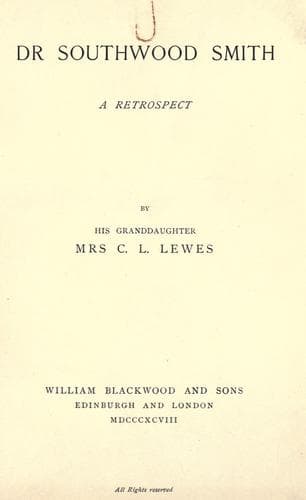
Dr. Southwood Smith: A RetrospectLewes, Gertrude Hill
History
Dr. Southwood Smith: A Retrospect
Lewes, Gertrude Hill
Physicians -- Great Britain -- Biography; Smith, Southwood, 1788-1861
Those who thus arrived at the great principle of the connection between
defective sanitary conditions and disease, laid the foundation of
Sanitary Reform. That connection is an old truth now,--one of those
about which it is difficult to realise that it could ever have been
unknown to the world; but in those days it was unknown and unrecognised,
and amongst the few who began to recognise it, there were scarcely any
who saw to what wide practical results such truths ought to lead.
My grandfather, however, saw that if the principle were once
established, not only would the quarantine laws, at that time absurd and
inefficacious, be modified; not only would our merchant ships be
released from spending long weary months in unhealthy ports, while their
crews were perhaps contracting, from their confinement, the very
diseases which they were supposed to have brought with them from foreign
lands; not only would the poor sufferers from plague and yellow fever
cease to be imprisoned in the poisoned districts whose air had just
given them the pestilence;--not only would these _false_ precautions
cease, but the true ones would be taken: the _causes_ of disease would
be removed; and thus, wherever a knowledge of this law spread and was
acted on, disease and death would diminish.
Might not, he thought, something practical be done _now_ and _here_ if
these facts were once generally known? Epidemics throughout follow the
same laws. Were not the very causes which produce plague in Egypt
operating now to produce typhus fever in Bethnal Green and Whitechapel?
We might not be able to stop the pestilential, moisture-laden wind that
came down to Cairo each year at the time of the inundation of the Nile,
but could we not do something towards purifying that which crept into
the rooms of our own poor from undrained courts and stagnant pools?
Could we not, if people once believed and acted on their belief, banish
the yearly epidemic fever from the back-streets of our large towns?
Dr Southwood Smith believed that this great result would follow from the
general acceptance of the truth of the principle he had announced. He
gave his life to spreading the knowledge of it.
By the articles in the 'Westminster Review' something was done towards
enlightening the public mind, for I find that they attracted the
attention of leading men in and out of Parliament, and were often
referred to in the debates in both Houses.
Public-domain text, read in full here on John Shaqi.
Reviews
Reviews
No reviews yet
Be the first to share your thoughts on this work.
Join the Discussion
Join the discussion
Sign in to leave a comment or review.
Sign InorCreate an account