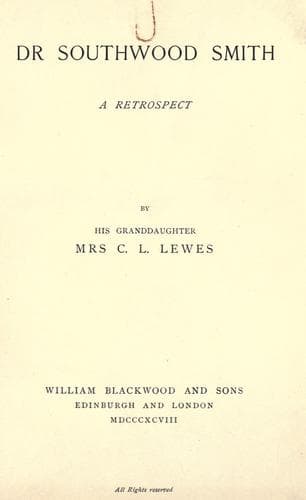
Dr. Southwood Smith: A RetrospectLewes, Gertrude Hill
History
Dr. Southwood Smith: A Retrospect
Lewes, Gertrude Hill
Physicians -- Great Britain -- Biography; Smith, Southwood, 1788-1861
Five years more of daily experience and constant thought passed before
his 'Treatise on Fever' was published.[6] It entered fully into all the
phenomena of the disease and into the question of its treatment. It
added largely to the knowledge of fever existing at that time, and was
welcomed by the medical profession. 'The Medico-Chirurgical Review,' the
highest authority of that day, pronounced it to be "the best work on
Fever that ever flowed from the pen of physician in any age or country."
It was for a long time the standard work on the subject with which it
dealt. The most important part of the work, however, as might be
expected, is that which relates, not to the treatment of disease (which
has since his time much changed) but to its _causes_. And here we find
an elaboration of the principles laid down five years before in his
articles in the 'Westminster Review.' Those articles had been the result
of a rapid glance which had gone to the very root of things, though when
they were written their writer had held his position at the Fever
Hospital for one year only, and had therefore not acquired the large
experience of fever which he subsequently attained. But the five years
that had passed since they were written could not change--could only
strengthen--his conviction of the truth of the principles which he had
previously expounded.
In the 'Treatise on Fever,' as in the articles just quoted, it is
enforced upon us, that since epidemics are everywhere the same, when
they reach our own country we must expect to find conditions similar to
those which produce pestilence in foreign countries. He writes as
follows:--
"_The room of a fever patient, in a small and heated apartment of
London, with no perflation of fresh air, is perfectly analogous to a
stagnant pool in Ethiopia full of the bodies of dead locusts. The poison
generated in both cases is the same; the difference is merely in the
degree of its potency. Nature with her burning sun, her stilled and
pent-up wind, her stagnant and teeming marsh, manufactures plague on a
large and fearful scale. Poverty in her hut, covered with her rags,
surrounded by her filth, striving with all her might to keep out the
pure air and to increase the heat, imitates Nature but too successfully;
the process and the product are the same, the only difference is in the
magnitude of the result. Penury and ignorance can thus, at any time and
in any place, create a mortal plague._"[7]
Dr Southwood Smith has been accused of ignoring the fact that those
suffering from fever can communicate the disease to others--of
"infection," as it is called. But he did not. He shows, on the contrary,
that the atmosphere of a room such as that spoken of in the passage just
quoted must have the power of inducing fever in others besides the
patient. He even says that "the poison formed by the exhalations given
off from the living bodies of those affected by fever is by far the most
potent febrile poison derived from animal origin."
Public-domain text, read in full here on John Shaqi.
Reviews
Reviews
No reviews yet
Be the first to share your thoughts on this work.
Join the Discussion
Join the discussion
Sign in to leave a comment or review.
Sign InorCreate an account