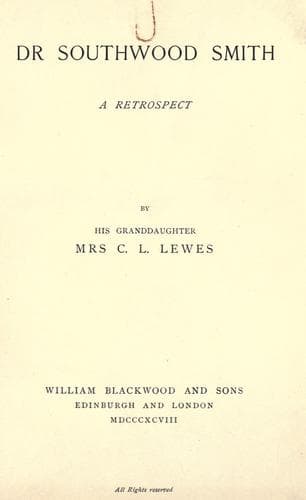
Dr. Southwood Smith: A RetrospectLewes, Gertrude Hill
History
Dr. Southwood Smith: A Retrospect
Lewes, Gertrude Hill
Physicians -- Great Britain -- Biography; Smith, Southwood, 1788-1861
Without bodies for dissection medical education was impossible, and at
that time there was only one legal means by which they could be
obtained: those of executed criminals were made over to the medical
profession for the purpose of dissection. But this source was, happily,
even then a scanty one. Until, therefore, some other provision was made,
the employment of "resurrection-men," though against the law, and in
itself revolting to the professors of anatomy, was a necessity.
The difficulty was an increasing one. The wretched men whose trade it
was to supply the medical schools were punished with imprisonment and
heavy fines, and were, not unnaturally, regarded with abhorrence by the
mob--such abhorrence that it was often difficult to protect them from
its fury when arrested. In Scotland, especially, this popular feeling
was so strong that disgraceful outrages were committed against those
even _suspected_ of being concerned in exhumation; the churchyards were
watched, and the obstacles in obtaining subjects for the schools had
become so many that the students were fast deserting them. Indeed
throughout Great Britain it appeared as if there would soon be a general
desertion of all the native schools, and that students would go to Paris
for the education they could not get at home.
In the article by Dr Southwood Smith which first called public attention
to these evils, he points out, in a very striking manner, the paramount
necessity of a supply of subjects. He reminds his readers of the wild
theories of former times when anatomical knowledge was not possessed,
and enforces on their attention the fact that this knowledge can only be
acquired, with any degree of perfection, by means of dissection. He
further reminds them that no operation can be performed without torture
to the living, and danger to life itself, by the hand of a surgeon
unpractised in dissection; and no clear judgment formed by the physician
on the diseases of the human frame--diseases generally seated in organs
hidden from the eye--without a study of the internal structure.
After shortly passing over the evils of the system then prevailing,
which have just been pointed out--evils which were then very generally
known--he suggests the remedy,--a very simple one. It was, to cease to
give the bodies of executed criminals for anatomical purposes, and thus
in a measure to take off the stigma on dissection; and then to
appropriate to that purpose the bodies of all those who die in hospitals
and workhouses _unclaimed by relatives_.
Nothing was done for some time, till in 1828, three years after this
paper was written, there came the horrible discovery that the difficulty
of obtaining subjects from the churchyards had become so great that two
men, Burke and Hare, had resorted to murder to supply the need--the
temptation having been the large price to be obtained for bodies.
Public-domain text, read in full here on John Shaqi.
Reviews
Reviews
No reviews yet
Be the first to share your thoughts on this work.
Join the Discussion
Join the discussion
Sign in to leave a comment or review.
Sign InorCreate an account