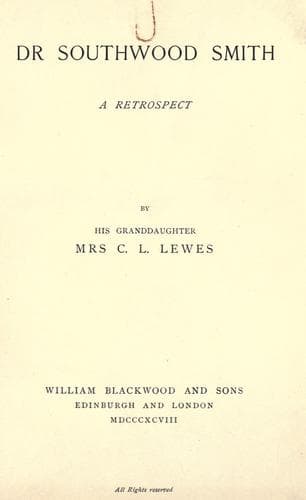
Dr. Southwood Smith: A RetrospectLewes, Gertrude Hill
History
Dr. Southwood Smith: A Retrospect
Lewes, Gertrude Hill
Physicians -- Great Britain -- Biography; Smith, Southwood, 1788-1861
It was said at the time by objectors that the measure in question would
deter patients from entering the hospitals, and add terrors to
workhouses, but experience has proved that my grandfather was right: the
adoption of his plan has not been found to have the slightest effect of
the kind.
In considering the work of this period of my grandfather's life, I ought
not to omit to mention his lectures, which were full of the same
earnestness and originality that characterised all he did. He was
lecturer at the Webb Street School of Anatomy, where he gave a course on
"Forensic Medicine," which made much impression at the time. He gave
also courses of popular lectures on physiology at the London Institution
and elsewhere. To those at the London Institution ladies were
admitted--a permission unusual in those times.
One lecture, delivered on a very remarkable occasion, must be mentioned
here. My grandfather was the friend and physician of Jeremy Bentham, and
was called upon, after his death, to perform a duty which he had
solemnly undertaken. The venerable philosopher died in 1832 at the age
of eighty-five, and by will desired that his body should be used for the
purposes of dissection. He intrusted to Dr Southwood Smith, in
conjunction with two other friends, the task of seeing this disposition
properly fulfilled, trusting that they would not be deterred by
opposition or obloquy.
This disposition of his body was not a recent act. By a will, dated as
far back as 1769, it was left, for the same purpose, to his friend Dr
Fordyce. The reason at that time assigned for this is expressed by
Bentham in the following remarkable words:--
"This my will and special request I make, not out of affectation of
singularity, but to the intent and with the desire that mankind may reap
some small benefit by my decease, having hitherto had small
opportunities to contribute thereto while living."
By a memorandum affixed to this document it is clear that it had
undergone revision as lately as two months before his death, and that
this part of it, originally made when he was twenty-one, was again
deliberately and solemnly confirmed by him at eighty-five.
In thus appropriating his remains to the service of mankind, Bentham
carried out, to the last moment of his life, and even after his death,
his principle of "Utility."
The subject of dissection was agitating the public mind: the "Anatomy
Bill" was not yet passed, and the idea might well present itself to a
benevolent mind such as his, that to show a thorough absence of horror
or dislike to the idea of being dissected after death would be a means
of lessening the prejudice which existed against it.
Whatever may be thought of the "greatest happiness principle" of this
philosopher, it did not cause him to lead a selfish or epicurean life.
The long calm expanse of eighty-five years was filled with simple
pleasures, with hard work, and contained many sacrifices to the cause of
truth.
Public-domain text, read in full here on John Shaqi.
Reviews
Reviews
No reviews yet
Be the first to share your thoughts on this work.
Join the Discussion
Join the discussion
Sign in to leave a comment or review.
Sign InorCreate an account