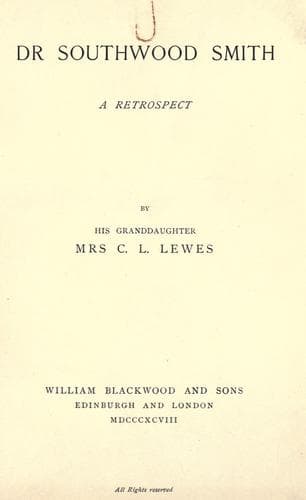
Dr. Southwood Smith: A RetrospectLewes, Gertrude Hill
History
Dr. Southwood Smith: A Retrospect
Lewes, Gertrude Hill
Physicians -- Great Britain -- Biography; Smith, Southwood, 1788-1861
He once more enforces the preventibleness of this dreadful state of
things--how entirely it was within the power of man to change it by wise
attention to the laws of health. He points out parts of the districts
which had always remained comparatively healthy, and some, formerly
haunts of fever, where during the last epidemic no single case had
occurred, owing to sanitary improvements.
The necessity for providing in some way for the airing of streets and
courts in densely populated neighbourhoods, by the knocking down of
houses or other expedients, is insisted upon. Its difficulty is
admitted, but still it is urged.
"Though it might seem a hopeless task," he says, "to set about
ventilating such districts as Bethnal Green and Whitechapel, yet, if the
importance of the principle be duly appreciated and the object be kept
steadily in view, much may be accomplished. In some of the worst
localities in these districts, at moderate expense, means might be taken
to introduce free currents of air, where at present the air is perfectly
stagnant and stifling. Some of the improvements recently made in the
City of London show to what extent it is possible to introduce good
ventilation into the heart of the most densely populated part of the
Metropolis."
In this Report my grandfather also draws attention to the state of the
Workhouses. He was writing to the Poor Law Commissioners, and so he
could efficiently bring under their notice the state of those buildings.
"From what I have observed I am satisfied," he says, "that many existing
workhouses are extremely deficient in space, ventilation, and drainage."
The overcrowding in the dormitories is especially pointed out. He
writes:--
"In going over the Whitechapel Workhouse I was struck with the statement
of the fact that, out of 104 children (girls) resident in that house, 89
have recently been attacked with fever. On examining the dormitory in
which these children sleep, my wonder ceased. In a room 88 feet long,
16-1/2 wide, and 7 feet high, with a sloping roof rising to 10 feet, all
these 104 children, together with four women who have the charge of
them, sleep. The beds are close to each other; in all the beds there are
never less than four children, in many five; the ventilation of the room
is most imperfect. Under such circumstances the breaking out of fever is
inevitable.
"I was likewise struck with the pale and unhealthy appearance of a
number of children in the Whitechapel Workhouse, in a room called the
'Infant Nursery.' These children appear to be from two to three years of
age; they are 23 in number, they all sleep in one room, and they seldom
or never go out of this room either for air or exercise. Several
attempts have been made to send these infants into the country, but a
majority of the Board of Guardians has hitherto succeeded in resisting
the proposition.
Public-domain text, read in full here on John Shaqi.
Reviews
Reviews
No reviews yet
Be the first to share your thoughts on this work.
Join the Discussion
Join the discussion
Sign in to leave a comment or review.
Sign InorCreate an account