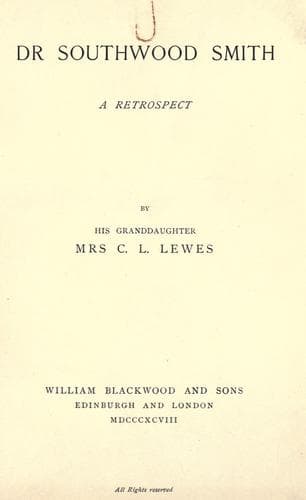
Dr. Southwood Smith: A RetrospectLewes, Gertrude Hill
History
Dr. Southwood Smith: A Retrospect
Lewes, Gertrude Hill
Physicians -- Great Britain -- Biography; Smith, Southwood, 1788-1861
My grandfather was much interested at this time in another effort of
which I have not yet spoken. It was the institution of a "Home in
Sickness" in London for those of the middle classes who might be far
from their own families, or who, from some other cause, could not secure
favourable surroundings in times of illness. The position of such people
struck him as very desolate. There were many with homes far
away--clerks, students, young men engaged in various professions,
governesses, and other ladies of limited income--who might be seized
with illness under circumstances when a return to their family was
impossible; others who had no family to which to return. It seemed to
him that chambers or lodgings which might be tolerably convenient for
people in health, were utterly unsuited to give the requisite comforts
when illness came: the poorer classes had the hospitals, but for this
intermediate class there was no provision.
His plan was, therefore, to found an institution into which, by
subscribing a small sum annually, members could secure a right to be
received when they were suffering from disease. They would each have a
separate room where an equal temperature could be secured, well prepared
diet, superior nursing, the advantage of a medical officer in the house
who could be called in at any moment, and the daily advice of skilled
physicians and surgeons specially appointed; or should the patients
prefer it, of their own medical advisers. For this they were to pay two
guineas a-week during their residence, or less, should it be found that
such an establishment could be self-supporting at a lower rate: that it
should be self-supporting was, he thought, essential.
Such an institution was founded in 1840 under very good auspices, and
opened under the name of "The Sanatorium" at Devonshire House, York
Gate, Regent's Park, in 1842. My grandfather freely gave it his medical
services, as well as his influence and supervision, for some years.
The house stood in a garden in which there were tall trees (with rooks
in them), making a cool green shade and shutting out all other houses;
whilst within doors the soft carpets and general feeling of quiet and
order gave a sense of peace. The contrast on turning into that garden
from the "New Road"[18] was striking. Quiet, indeed, was one of the
chief boons which the Sanatorium could offer.
Charles Dickens, one of its earliest supporters, speaks forcibly of this
contrast in a speech made in behalf of the Institution. He speaks of the
noise of crowded streets and busy thoroughfares as--
Public-domain text, read in full here on John Shaqi.
Reviews
Reviews
No reviews yet
Be the first to share your thoughts on this work.
Join the Discussion
Join the discussion
Sign in to leave a comment or review.
Sign InorCreate an account