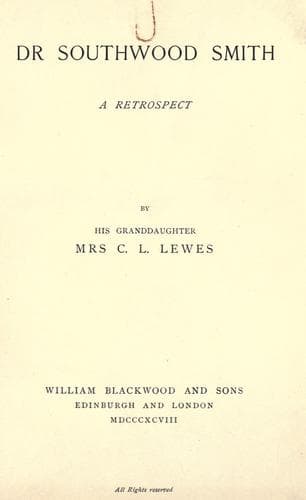
Dr. Southwood Smith: A RetrospectLewes, Gertrude Hill
History
Dr. Southwood Smith: A Retrospect
Lewes, Gertrude Hill
Physicians -- Great Britain -- Biography; Smith, Southwood, 1788-1861
"That never-ceasing restlessness, that incessant tread of feet wearing
the rough stones smooth and glossy." "Is it not a wonder," he says,--"is
it not a wonder, how the dwellers in narrow ways can bear it? Think of a
sick man in such a place as St Martins Court, listening to the
footsteps, and in the midst of pain and weariness obliged, despite
himself (as though it were a task he must perform), to detect the
child's step from the man's; the slipshod beggar from the hooded
exquisite; the lounging from the busy. Think of the hum and noise always
present to his senses, and of the stream of life that will not stop,
pouring on, on, on, through all his restless dreams, as if he were
condemned to lie dead, but conscious, in a noisy churchyard, and had no
hope of rest for centuries to come."
After some time it was found that a building specially constructed,
which should contain many small separate rooms, would be more suitable
and less expensive than Devonshire House. To erect this it was necessary
to raise a building fund. By this time the Institution was supported by
a powerful list of patrons, with Prince Albert at their head; many large
banking-houses and City firms had subscribed to it for the sake of their
clerks and others; and more than a hundred members of the medical
profession had visited it, and had signed a statement expressing their
belief in the need of such an establishment, adding that the Sanatorium
had supplied this need most satisfactorily, though on a small scale.
Charles Dickens then lived nearly opposite to Devonshire House, and when
the building fund was opened, he and several other literary men and
artists came forward and gave for its benefit the first of those amateur
performances which they repeated at a later period. They acted Ben
Jonson's "Every Man in his Humour," at St James's Theatre, on November
15, 1845, both audience and actors being brilliant. Charles Dickens,
Douglas Jerrold, John Foster, Mark Lemon, Frank Stone, and others took
part. I remember seeing them, as I peeped down from a side-box.
The Sanatorium did not, from a money point of view, succeed; but it was,
nevertheless, the forerunner of all those "Home Hospitals" and "Nursing
Homes" which have since proved so great a boon to the public. So that in
this, also, my grandfather was a pioneer.
As the name of Dickens has been mentioned, it may be interesting to
refer here to some of the letters which show the early and keen interest
he felt in the removal of the evils with which my grandfather was
contending, and his readiness to give his aid to the cause of the poor.
Here is the first letter, alluding both to the Sanatorium and to the
Children's Employment Commission:--
[Illustration: Letter from Charles Dickens] [Illustration: Letter from
Charles Dickens] [Illustration: Letter from Charles Dickens]
1 DEVONSHIRE TERRACE, YORK GATE,
_Fifteenth December 1840_.
Public-domain text, read in full here on John Shaqi.
Reviews
Reviews
No reviews yet
Be the first to share your thoughts on this work.
Join the Discussion
Join the discussion
Sign in to leave a comment or review.
Sign InorCreate an account