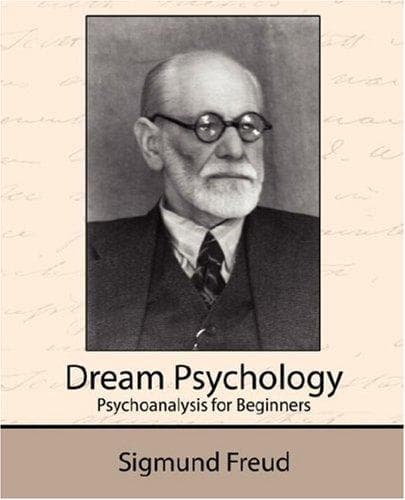
Dream Psychology: Psychoanalysis for BeginnersFreud, Sigmund
Science
Dream Psychology: Psychoanalysis for Beginners
Freud, Sigmund
Dreams; Psychoanalysis
When I termed one of the psychic processes in the psychic apparatus the
primary process, I did so not only in consideration of the order of
precedence and capability, but also as admitting the temporal relations
to a share in the nomenclature. As far as our knowledge goes there is no
psychic apparatus possessing only the primary process, and in so far it
is a theoretic fiction; but so much is based on fact that the primary
processes are present in the apparatus from the beginning, while the
secondary processes develop gradually in the course of life, inhibiting
and covering the primary ones, and gaining complete mastery over them
perhaps only at the height of life. Owing to this retarded appearance of
the secondary processes, the essence of our being, consisting in
unconscious wish feelings, can neither be seized nor inhibited by the
foreconscious, whose part is once for all restricted to the indication
of the most suitable paths for the wish feelings originating in the
unconscious. These unconscious wishes establish for all subsequent
psychic efforts a compulsion to which they have to submit and which
they must strive if possible to divert from its course and direct to
higher aims. In consequence of this retardation of the foreconscious
occupation a large sphere of the memory material remains inaccessible.
Among these indestructible and unincumbered wish feelings originating
from the infantile life, there are also some, the fulfillments of which
have entered into a relation of contradiction to the end-presentation of
the secondary thinking. The fulfillment of these wishes would no longer
produce an affect of pleasure but one of pain; _and it is just this
transformation of affect that constitutes the nature of what we
designate as "repression," in which we recognize the infantile first
step of passing adverse sentence or of rejecting through reason_. To
investigate in what way and through what motive forces such a
transformation can be produced constitutes the problem of repression,
which we need here only skim over. It will suffice to remark that such a
transformation of affect occurs in the course of development (one may
think of the appearance in infantile life of disgust which was
originally absent), and that it is connected with the activity of the
secondary system. The memories from which the unconscious wish brings
about the emotional discharge have never been accessible to the Forec.,
and for that reason their emotional discharge cannot be inhibited. It
is just on account of this affective development that these ideas are
not even now accessible to the foreconscious thoughts to which they have
transferred their wishing power. On the contrary, the principle of pain
comes into play, and causes the Forec. to deviate from these thoughts of
transference. The latter, left to themselves, are "repressed," and thus
the existence of a store of infantile memories, from the very beginning
Public-domain text, read in full here on John Shaqi.
Reviews
Reviews
No reviews yet
Be the first to share your thoughts on this work.
Elsewhere in the archive
Join the Discussion
Join the discussion
Sign in to leave a comment or review.
Sign InorCreate an account