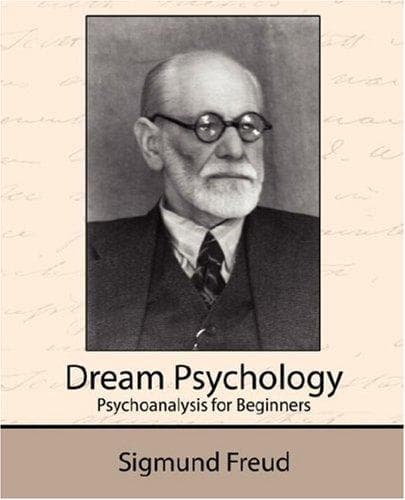
Dream Psychology: Psychoanalysis for BeginnersFreud, Sigmund
Science
Dream Psychology: Psychoanalysis for Beginners
Freud, Sigmund
Dreams; Psychoanalysis
The dream thoughts which we learn from the analysis exhibit themselves
as a psychical complex of the most complicated superstructure. Their
parts stand in the most diverse relationship to each other; they form
backgrounds and foregrounds, stipulations, digressions, illustrations,
demonstrations, and protestations. It may be said to be almost the rule
that one train of thought is followed by its contradictory. No feature
known to our reason whilst awake is absent. If a dream is to grow out of
all this, the psychical matter is submitted to a pressure which
condenses it extremely, to an inner shrinking and displacement, creating
at the same time fresh surfaces, to a selective interweaving among the
constituents best adapted for the construction of these scenes. Having
regard to the origin of this stuff, the term _regression_ can be fairly
applied to this process. The logical chains which hitherto held the
psychical stuff together become lost in this transformation to the dream
content. The dream work takes on, as it were, only the essential content
of the dream thoughts for elaboration. It is left to analysis to restore
the connection which the dream work has destroyed.
The dream's means of expression must therefore be regarded as meager in
comparison with those of our imagination, though the dream does not
renounce all claims to the restitution of logical relation to the dream
thoughts. It rather succeeds with tolerable frequency in replacing these
by formal characters of its own.
By reason of the undoubted connection existing between all the parts of
dream thoughts, the dream is able to embody this matter into a single
scene. It upholds a _logical connection_ as _approximation in time and
space_, just as the painter, who groups all the poets for his picture of
Parnassus who, though they have never been all together on a mountain
peak, yet form ideally a community. The dream continues this method of
presentation in individual dreams, and often when it displays two
elements close together in the dream content it warrants some special
inner connection between what they represent in the dream thoughts. It
should be, moreover, observed that all the dreams of one night prove on
analysis to originate from the same sphere of thought.
The causal connection between two ideas is either left without
presentation, or replaced by two different long portions of dreams one
after the other. This presentation is frequently a reversed one, the
beginning of the dream being the deduction, and its end the hypothesis.
The direct _transformation_ of one thing into another in the dream seems
to serve the relationship of _cause_ and _effect_.
The dream never utters the _alternative "either-or,"_ but accepts both
as having equal rights in the same connection. When "either-or" is used
in the reproduction of dreams, it is, as I have already mentioned, to be
replaced by "_and_."
Public-domain text, read in full here on John Shaqi.
Reviews
Reviews
No reviews yet
Be the first to share your thoughts on this work.
Join the Discussion
Join the discussion
Sign in to leave a comment or review.
Sign InorCreate an account