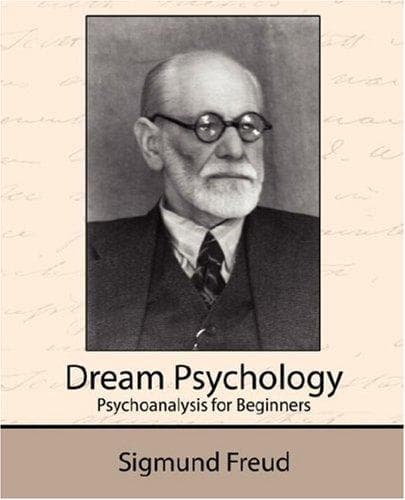
Dream Psychology: Psychoanalysis for BeginnersFreud, Sigmund
Science
Dream Psychology: Psychoanalysis for Beginners
Freud, Sigmund
Dreams; Psychoanalysis
Conceptions which stand in opposition to one another are preferably
expressed in dreams by the same element.[2] There seems no "not" in
dreams. Opposition between two ideas, the relation of conversion, is
represented in dreams in a very remarkable way. It is expressed by the
reversal of another part of the dream content just as if by way of
appendix. We shall later on deal with another form of expressing
disagreement. The common dream sensation of _movement checked_ serves
the purpose of representing disagreement of impulses--a _conflict of the
will_.
Only one of the logical relationships--that of _similarity, identity,
agreement_--is found highly developed in the mechanism of dream
formation. Dream work makes use of these cases as a starting-point for
condensation, drawing together everything which shows such agreement to
a _fresh unity_.
These short, crude observations naturally do not suffice as an estimate
of the abundance of the dream's formal means of presenting the logical
relationships of the dream thoughts. In this respect, individual dreams
are worked up more nicely or more carelessly, our text will have been
followed more or less closely, auxiliaries of the dream work will have
been taken more or less into consideration. In the latter case they
appear obscure, intricate, incoherent. When the dream appears openly
absurd, when it contains an obvious paradox in its content, it is so of
purpose. Through its apparent disregard of all logical claims, it
expresses a part of the intellectual content of the dream ideas.
Absurdity in the dream denotes _disagreement, scorn, disdain_ in the
dream thoughts. As this explanation is in entire disagreement with the
view that the dream owes its origin to dissociated, uncritical cerebral
activity, I will emphasize my view by an example:
_"One of my acquaintances, Mr. M----, has been attacked by no less a
person than Goethe in an essay with, we all maintain, unwarrantable
violence. Mr. M---- has naturally been ruined by this attack. He
complains very bitterly of this at a dinner-party, but his respect for
Goethe has not diminished through this personal experience. I now
attempt to clear up the chronological relations which strike me as
improbable. Goethe died in 1832. As his attack upon Mr. M---- must, of
course, have taken place before, Mr. M---- must have been then a very
young man. It seems to me plausible that he was eighteen. I am not
certain, however, what year we are actually in, and the whole
calculation falls into obscurity. The attack was, moreover, contained
in Goethe's well-known essay on 'Nature.'"_
The absurdity of the dream becomes the more glaring when I state that
Mr. M---- is a young business man without any poetical or literary
interests. My analysis of the dream will show what method there is in
this madness. The dream has derived its material from three sources:
Public-domain text, read in full here on John Shaqi.
Reviews
Reviews
No reviews yet
Be the first to share your thoughts on this work.
Join the Discussion
Join the discussion
Sign in to leave a comment or review.
Sign InorCreate an account