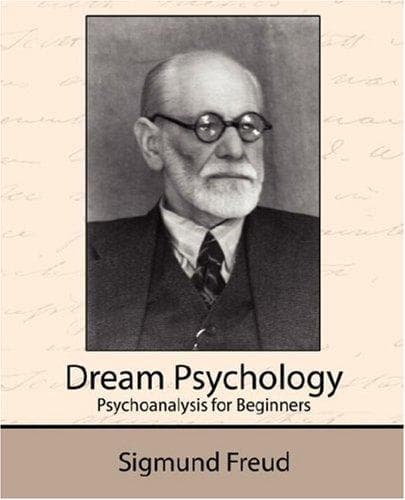
Dream Psychology: Psychoanalysis for BeginnersFreud, Sigmund
Science
Dream Psychology: Psychoanalysis for Beginners
Freud, Sigmund
Dreams; Psychoanalysis
1. Mr. M----, to whom I was introduced at a dinner-party, begged me one
day to examine his elder brother, who showed signs of mental trouble. In
conversation with the patient, an unpleasant episode occurred. Without
the slightest occasion he disclosed one of his brother's _youthful
escapades_. I had asked the patient the _year of his birth_ (_year of
death_ in dream), and led him to various calculations which might show
up his want of memory.
2. A medical journal which displayed my name among others on the cover
had published a _ruinous_ review of a book by my friend F---- of Berlin,
from the pen of a very _juvenile_ reviewer. I communicated with the
editor, who, indeed, expressed his regret, but would not promise any
redress. Thereupon I broke off my connection with the paper; in my
letter of resignation I expressed the hope that our _personal relations
would not suffer from this_. Here is the real source of the dream. The
derogatory reception of my friend's work had made a deep impression upon
me. In my judgment, it contained a fundamental biological discovery
which only now, several years later, commences to find favor among the
professors.
3. A little while before, a patient gave me the medical history of her
brother, who, exclaiming "_Nature, Nature!_" had gone out of his mind.
The doctors considered that the exclamation arose from a study of
_Goethe's_ beautiful essay, and indicated that the patient had been
overworking. I expressed the opinion that it seemed more _plausible_ to
me that the exclamation "Nature!" was to be taken in that sexual meaning
known also to the less educated in our country. It seemed to me that
this view had something in it, because the unfortunate youth afterwards
mutilated his genital organs. The patient was eighteen years old when
the attack occurred.
The first person in the dream-thoughts behind the ego was my friend who
had been so scandalously treated. _"I now attempted to clear up the
chronological relation."_ My friend's book deals with the chronological
relations of life, and, amongst other things, correlates _Goethe's_
duration of life with a number of days in many ways important to
biology. The ego is, however, represented as a general paralytic (_"I
am not certain what year we are actually in"_). The dream exhibits my
friend as behaving like a general paralytic, and thus riots in
absurdity. But the dream thoughts run ironically. "Of course he is a
madman, a fool, and you are the genius who understands all about it. But
shouldn't it be the _other way round_?" This inversion obviously took
place in the dream when Goethe attacked the young man, which is absurd,
whilst any one, however young, can to-day easily attack the great
Goethe.
Public-domain text, read in full here on John Shaqi.
Reviews
Reviews
No reviews yet
Be the first to share your thoughts on this work.
Join the Discussion
Join the discussion
Sign in to leave a comment or review.
Sign InorCreate an account