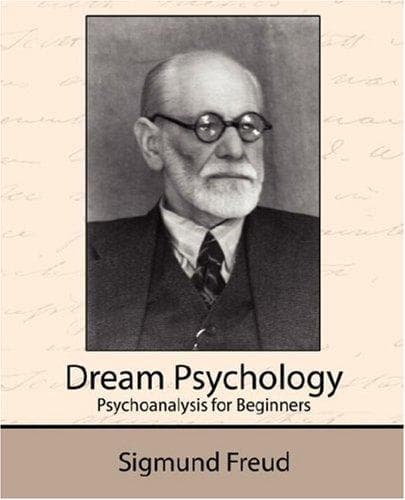
Dream Psychology: Psychoanalysis for BeginnersFreud, Sigmund
Science
Dream Psychology: Psychoanalysis for Beginners
Freud, Sigmund
Dreams; Psychoanalysis
A girl dreamt that she saw lying dead before her the only surviving
child of her sister amid the same surroundings as a few years before she
saw the first child lying dead. She was not sensible of any pain, but
naturally combatted the view that the scene represented a desire of
hers. Nor was that view necessary. Years ago it was at the funeral of
the child that she had last seen and spoken to the man she loved. Were
the second child to die, she would be sure to meet this man again in her
sister's house. She is longing to meet him, but struggles against this
feeling. The day of the dream she had taken a ticket for a lecture,
which announced the presence of the man she always loved. The dream is
simply a dream of impatience common to those which happen before a
journey, theater, or simply anticipated pleasures. The longing is
concealed by the shifting of the scene to the occasion when any joyous
feeling were out of place, and yet where it did once exist. Note,
further, that the emotional behavior in the dream is adapted, not to the
displaced, but to the real but suppressed dream ideas. The scene
anticipates the long-hoped-for meeting; there is here no call for
painful emotions.
There has hitherto been no occasion for philosophers to bestir
themselves with a psychology of repression. We must be allowed to
construct some clear conception as to the origin of dreams as the first
steps in this unknown territory. The scheme which we have formulated not
only from a study of dreams is, it is true, already somewhat
complicated, but we cannot find any simpler one that will suffice. We
hold that our psychical apparatus contains two procedures for the
construction of thoughts. The second one has the advantage that its
products find an open path to consciousness, whilst the activity of the
first procedure is unknown to itself, and can only arrive at
consciousness through the second one. At the borderland of these two
procedures, where the first passes over into the second, a censorship
is established which only passes what pleases it, keeping back
everything else. That which is rejected by the censorship is, according
to our definition, in a state of repression. Under certain conditions,
one of which is the sleeping state, the balance of power between the two
procedures is so changed that what is repressed can no longer be kept
back. In the sleeping state this may possibly occur through the
negligence of the censor; what has been hitherto repressed will now
succeed in finding its way to consciousness. But as the censorship is
never absent, but merely off guard, certain alterations must be conceded
so as to placate it. It is a compromise which becomes conscious in this
case--a compromise between what one procedure has in view and the
demands of the other. _Repression, laxity of the censor,
compromise_--this is the foundation for the origin of many another
psychological process, just as it is for the dream. In such compromises
Public-domain text, read in full here on John Shaqi.
Reviews
Reviews
No reviews yet
Be the first to share your thoughts on this work.
Join the Discussion
Join the discussion
Sign in to leave a comment or review.
Sign InorCreate an account