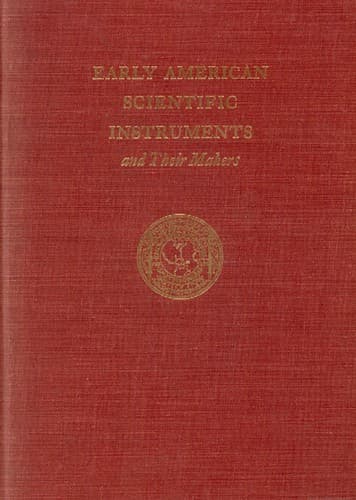
Early American Scientific Instruments and Their Makers — John Shaqi
Early American Scientific Instruments and Their MakersBedini, Silvio A.
History
Early American Scientific Instruments and Their Makers
Bedini, Silvio A.
Scientific apparatus and instruments
The colonial school curriculum was accordingly designed from the
practical point of view to emphasize practical mathematics, and there
was an increasing demand for instruction in all aspects of the subject.
One of the earliest advertisements of this nature appeared in _The
Boston Gazette_ in March 1719. In the issue of February 19 to March 7
the advertisement stated that:
This day Mr. Samuel Grainger opens his school at the House formerly
Sir Charles Hobby's, where will be taught Grammar Writing after a
free and easy manner in all the usual Hands, Arithmetick in a
concise and Practical Method, Merchants Accompts, and the
Mathematicks.
He hopes that more thinking People will in no wise be discouraged
from sending their children thither, on the account of the reports
newly reviv'd, because these dancing Phaenomena's were never seen
nor heard of in School Hours.
The advertisement was further amplified in its second appearance, in the
issue of March 21-22, 1719:
At the house formerly Sir Charles Hobby's are taught grammar,
writing, after a free & easy manner in all hands usually practiced,
Arithmetick Vulgar and Decimal in a concise and Practical Method,
Merchants Accompts, Geometry, Algebra, Mensuration, Geography,
Trigonometry, Astronomy, Navigation and other parts of the
Mathematicks, with the use of the Globes and other Mathematical
Instruments, by Samuel Grainger.
They whose business won't permit 'em to attend the usual School
Hours, shall be carefully attended and Instructed in the Evenings.
R. F. Seybold[4] has noted that: "In advertisements of 1753 and 1754,
John Lewis, of New York City, announced 'What is called a New Method of
Navigation, is an excellent Method of Trigonometry here particularly
applied to Navigation; But it is of great use in all kinds of measuring
and in solving many Arithmetical Questions.' James Cosgrove, of
Philadelphia, in 1755, taught 'geometry, trigonometry, and their
application in surveying, navigation, etc.,' and Alexander Power, in
1766, 'With their Application to Surveying, Navigation, Geography, and
Astronomy'." These subjects were featured also in the evening schools of
the colonial period, maintained by private schoolmasters in some of the
larger communities for the education of those who could not attend
school in the daytime.
Public-domain text, read in full here on John Shaqi.
Reviews
Reviews
No reviews yet
Be the first to share your thoughts on this work.
Join the Discussion
Join the discussion
Sign in to leave a comment or review.
Sign InorCreate an account