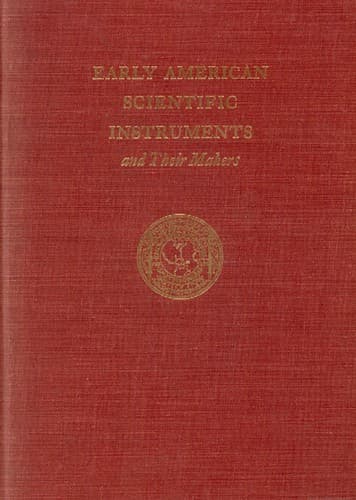
Early American Scientific Instruments and Their Makers — John Shaqi
Early American Scientific Instruments and Their MakersBedini, Silvio A.
History
Early American Scientific Instruments and Their Makers
Bedini, Silvio A.
Scientific apparatus and instruments
According to Seybold, surveying and navigation were the most popular
mathematical subjects taught. Some explanation is to be derived from the
statement by Schoen[5] that: "In the days when the 'bounds' of great
wilderness tracts were being marked off by deep-cut blazes in the trees
along a line, a knowledge of land surveying was a useful skill, and many
a boy learned its elements by following the 'boundsgoer' in his work of
'running the line.' And those who did not actually take part in running
the line must have attended many a gay springtime 'processioning' when
neighbors made a festive occasion out of 'perambulating the bounds'."
"Vague land grants and inaccurate surveys," he adds, "made the subject
of boundary lines a prime issue in the everyday life of colonial homes."
At the same time there was interest in the other aspects of the
mathematical sciences. As early as 1743, for instance, a Harvard
mathematician named Nathan Prince advertised in Boston that if he were
given "suitable Encouragement" he would establish a school to teach
"Geography and Astronomy, With the Use of the Globes, and the several
kinds of Projecting the Sphere" among other things.[6] A decade later,
Theophilus Grew, professor in the academy at Philadelphia which has
become the University of Pennsylvania, published a treatise on globes,
with the title:
_The Description_ and _Use_ of the _Globes_, Celestial and
Terrestrial; With Variety for _Examples_ for the Learner's
_Exercises_: Intended for the Use of Such Persons as would attain
to the Knowledge of those _Instruments_; But Chiefly designed for
the _Instruction_ of the young _Gentlemen_ at the _Academy_ in
Philadelphia. To which is added Rules for working all the Cases in
Plain and Spherical Triangles without a Scheme. By _Theophilus
Grew_, Mathematical Professor. Germantown, Printed by Christopher
Sower, 1753.[7]
Thus, the need for practical mathematical instruments for the surveyor
and navigator became critical in proportion to the need for men to make
and use them, and it is not surprising to discover that the majority of
the instruments produced and advertised by early American makers were
for surveying, with nautical instruments in second place. Generally, the
surveyors were not professionals; they were farmers, tradesmen, or
craftsmen with a sound knowledge of basic arithmetic and occasionally
with some advanced study of the subject as taught in the evening
schools. The surveying of provincial and intercolonial boundaries
required greater skill, however, as well as a knowledge of astronomy,
and this work was relegated to the scientific men of the period.
Public-domain text, read in full here on John Shaqi.
Reviews
Reviews
No reviews yet
Be the first to share your thoughts on this work.
Join the Discussion
Join the discussion
Sign in to leave a comment or review.
Sign InorCreate an account