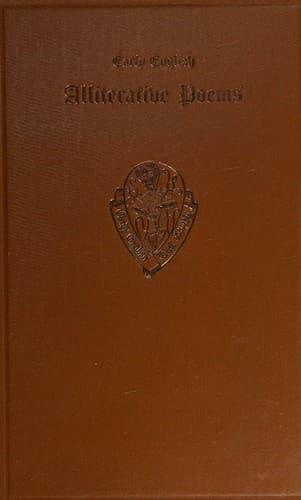
Early English Alliterative Poems: in the West-Midland Dialect of the Fourteenth Century — John Shaqi
Early English Alliterative Poems: in the West-Midland Dialect of the Fourteenth Century
Religion
Early English Alliterative Poems: in the West-Midland Dialect of the Fourteenth Century
English poetry -- Middle English, 1100-1500
In þe palays pryncipale vpon þe playn wowe
_In the palace principal upon the plain wall,_
In contrary of þe candelstik þat clerest hit schyned
_Opposite to the candlestick that clearest there shone._
Þer apered a paume, with poyntel in fyngres
_There appeared a palm with a pointel in its fingers,_
Þat watȝ grysly & gret, & grymly he wrytes
_That was grisly and great, and grimly it writes,_
None oþer forme bot a fust faylaynde þe wryst
_None other form but a fist failing the wrist_
Pared on þe parget, purtrayed lettres
_Pared on the plaister, pourtrayed letters._
When þat bolde Baltaȝar blusched to þat neue
_When that bold Belshazzar looked to that fist,_
Such a dasande drede dusched to his hert
_Such a dazzling dread dashed to his heart._
Þat al falewed his face & fayled þe chere
_That all paled his face and failed the cheer;_
Þe stronge strok of þe stonde strayned his ioyntes
_The strong stroke of the blow strained his joints,_
His cnes cachcheȝ to close & cluchches his hommes
_His knees catch to close, and he clutches his hams,_
& he with plat-tyng his paumes displayes his lers[19]
_And he with striking his palms displays his fears,_
& romyes as a rad ryth þat roreȝ for drede
_And howls as a frightened hound that roars for dread,_
Ay biholdand þe honde til hit hade al grauen,
_Ever beholding the hand till it had all graven,_
& rasped on þe roȝ woȝe runisch saueȝ
_And rasped on the rough wall uncouth saws (words)._
(IX.) The story of Nebuchadnezzar’s pride and its punishment (pp. 84,
85), and the interpretation of the handwriting by Daniel (p. 86).
(X.) The invasion of Babylon by the Medes (pp. 87, 88).
Baltaȝar in his bed watȝ beten to deþe
_Belshazzar in his bed was beaten to death,_
Þat boþe his blood & his brayn blende on þe cloþes
_That both his blood and his brains blended on the clothes;_
Þe kyng in his cortyn watȝ kaȝt by þe heles
_The king in his curtain was caught by the heels,_
Feryed out bi þe fete & fowle dispysed
_Ferried out by the feet and foully despised;_
Þat watȝ so doȝty þat day & drank of þe vessayl
_He that was so doughty that day and drank of the vessels,_
Now is a dogge also dere þat in a dych lygges
_Now is as dear (valuable) as a dog that in a ditch lies._ --(p. 88.)
[Footnote 16: See Glossary.]
[Footnote 17: “4. And the city was broken up, and all the men of
war fled by night by the way of the gate between two walls, which
is by the king’s garden: (now the Chaldees were against the city
round about:) and the king went the way toward the plain.
“5. And the army of the Chaldees pursued after the king, and
overtook him in the plains of Jericho: and all his army were
scattered from him.”]
[Footnote 18: Immediately.]
[Footnote 19: ? feres.]
Public-domain text, read in full here on John Shaqi.
Reviews
Reviews
No reviews yet
Be the first to share your thoughts on this work.
Join the Discussion
Join the discussion
Sign in to leave a comment or review.
Sign InorCreate an account