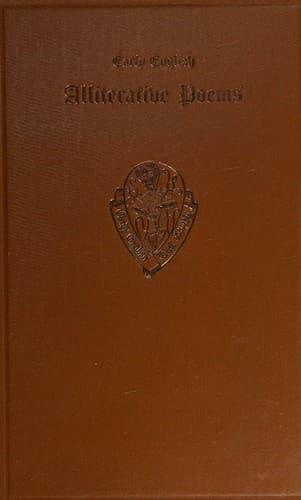
Early English Alliterative Poems: in the West-Midland Dialect of the Fourteenth Century — John Shaqi
Early English Alliterative Poems: in the West-Midland Dialect of the Fourteenth Century
Religion
Early English Alliterative Poems: in the West-Midland Dialect of the Fourteenth Century
English poetry -- Middle English, 1100-1500
The third poem, entitled “_Patience_,” is a paraphrase of the book of
Jonah. The writer prefaces it with a few remarks of his own in order to
show that “patience is a noble point though it displease oft.”
The following extract contains a description of the sea-storm which
overtook Jonah:--
Anon out of þe norþ est þe noys bigynes
_Anon out of the north east the noise begins,_
When boþe breþes[20] con blowe vpon blo watteres
_When both breezes did blow upon blue waters:_
Roȝ rakkes þer ros with rudnyng an-vnder
_Rough clouds there arose with lightning there under,_
Þe see souȝed ful sore, gret selly to here
_The sea sobbed full sore, great marvel to hear;_
Þe wyndes on þe wonne water so wrastel togeder,
_The winds on the wan water so wrestle together,_
Þat þe wawes ful wode waltered so hiȝe
_That the waves full wild rolled so high,_
& efte busched to þe abyme þat breed fyssches
_And again bent to the abyss that bred fishes;_
Durst nowhere for roȝ arest at þe bothem.
_Durst it nowhere for roughness rest at the bottom._
When þe breth & þe brok & þe bote metten
_When the breeze and the brook and the boat met,_
Hit watȝ a ioyles gyn þat Ionas watȝ inne
_It was a joyless engine that Jonah was in,_
For hit reled on round vpon þe roȝe yþes
_For it reeled around upon the rough waves._
Þe bur ber to hit baft þat braste alle her gere
_The bore (wave) bear to it abaft that burst all her gear,_
Þen hurled on a hepe þe helme & þe sterne
_Then hurled on a heap the helm and the stern,_
Furste to murte[21] mony rop & þe mast after
_First marred[21] many a rope and the mast after._
Þe sayl sweyed on þe see, þenne suppe bihoued
_The sail swung on the sea, then sup behoved_
Þe coge of þe colde water, & þenne þe cry ryses
_The boat of the cold water, and then the cry rises;_
Ȝet coruen þay þe cordes & kest al þer-oute
_Yet cut they the cords and cast all there-out._
Mony ladde þer forth-lep to laue & to kest
_Many a lad there forth leapt to lave and to cast,_
Scopen out þe scaþel water, þat fayn scape wolde
_To scoop out the scathful water that fain escape would;_
For be monnes lode neuer so luþer, þe lyf is ay swete
_For be man’s lot never so bad, the life is aye sweet._ --(p. 93.)
The writer, in concluding the story of Jonah, exhorts his readers to be
“patient in pain and in joy.”
For he þat is to rakel to renden his cloþeȝ,
Mot efte sitte with more vn-sounde to sewe hem togeder.
_For he that is too rash to rend his clothes,
Must afterwards sit with more unsound (worse ones)
to sew them together._ (p. 104.)
[Footnote 20: Eurus and Aquilo.]
[Footnote 21: ? = to-marte.]
Public-domain text, read in full here on John Shaqi.
Reviews
Reviews
No reviews yet
Be the first to share your thoughts on this work.
Join the Discussion
Join the discussion
Sign in to leave a comment or review.
Sign InorCreate an account