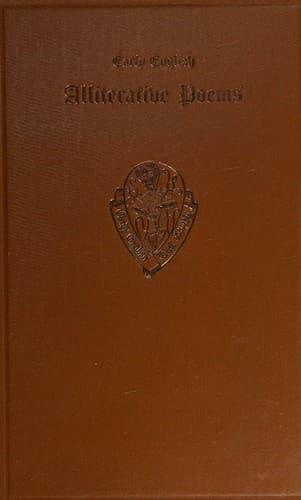
Early English Alliterative Poems: in the West-Midland Dialect of the Fourteenth Century
Religion
Early English Alliterative Poems: in the West-Midland Dialect of the Fourteenth Century
English poetry -- Middle English, 1100-1500
[Footnote 30: The Midland dialect is a very difficult one to deal
with, as it presents us with no uniform type; and, moreover, works
written in this idiom are marked by Northern or Southern
peculiarities, which have led many of our editors altogether
astray in determining the locality of their composition.]
[Footnote 31: Published by the Camden Society, 1842.]
[Footnote 32: Edited by Mr. Halliwell for the Percy Society.]
[Footnote 33: Edited by me for the Philological Society, 1862.]
[Footnote 34: _-us_ and _-ud_ for _-es_ and _-ed_, as well as
_hom_, _hor_, do occasionally occur in the MS. containing our
poems.]
[Footnote 35: The Romance of William and the Werwolf is written in
the West-Midland dialect as spoken probably in Shropshire.]
[Footnote 36: Robson’s Metrical Romances, p. 54, l. 9.]
[Footnote 37: _Woldus_ = _woldes_ = _wouldst_, appears in
Audelay’s poems (in the Shropshire dialect of the fifteenth
century), p. 32, l. 6.]
[Footnote 38: The so-called Northumbrian records of the ninth and
tenth centuries frequently use _-es_ instead of _-est_, in the 2nd
pers. preterite of regular verbs, _e.g._,
_ðu forcerdes usic on-bec_ = Thou turnedst us hindward.
--(Ps. xliii. 11.)
_ðu saldes usic_ = Thou gavest us. --(Ps. xliii. 12.)
_ðu bi-bohtes folc ðin butan weorðe_ = Thou soldest thy folk
without price. --(Ps. xliii. 12.)
ðu _ge-hiowades_ me & _settes_ ofer me hond ðine = Thou madest me
and settest over me thy hand. --(Ps. cxxxviii. 5.)
ðu _ðreades ða_ ofer-hygdan = Thou hast rebuked the proud.
--(Ps. cxviii. 21.)
Ic ondeto ðe fader drihten heofnes forðon ðu _gedeigeldes_ ðas
ilco from snotrum & hogum & _ædeaudes_ ða ðæm lytlum = I thank
thee, O father, Lord of heaven and earth, because thou hast hid
these things from the wise and prudent, and hast revealed them
unto babes. --(Matt. xi. 25).]
[Footnote 39: Þou _torned_ us hindward. --(Early English Nn.
Psalter, xliii. 11.)
Þou _salde_ þi folk. --(_Ibid._ xliii. 12.)
Þou _meked_ us. --(_Ibid._ xliii. 20.)
Þou _made_ me and set þi hand over me. --(_Ibid._ cxxxviii. 5.)
Þou _snibbed_ proude. --(_Ibid._ cxviii. 21.)]
[Footnote 40: I am informed by a Shropshire friend that it
prevails in his county under the form _shinneh_.
_Win_ = will, in _winnot_, _wunnot_ = will not, is still heard in
the West-Midland districts. It is found in Robson’s Romances and
in Liber Cure Cocorum.]
[Footnote 41: They _shall_ know soon there is no goodness in man
like Belshazzar’s virtues.]
[Footnote 42: And those that seemly are and sweet _shall_ see His
(God’s) face.]
[Footnote 43: Peacocks and partriches parboiled _shall_ be.]
[Footnote 44: For þer are beasts þat _shall_ be roasted.]
[Footnote 45: All _shall_ be drawn (have the entrails removed),
Sir, at the side.]
Public-domain text, read in full here on John Shaqi.
Reviews
Reviews
No reviews yet
Be the first to share your thoughts on this work.
Join the Discussion
Join the discussion
Sign in to leave a comment or review.
Sign InorCreate an account