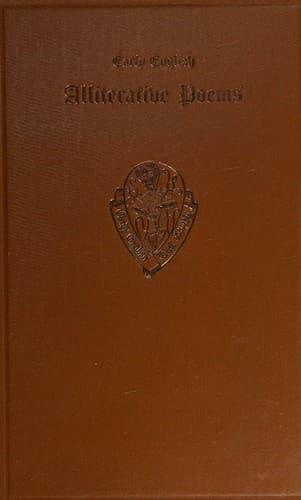
Early English Alliterative Poems: in the West-Midland Dialect of the Fourteenth Century
Religion
Early English Alliterative Poems: in the West-Midland Dialect of the Fourteenth Century
English poetry -- Middle English, 1100-1500
Wyþerly, fiercely, angrily, B. 198; C. 74.
Wyth-halde, withhold, B. 740.
Wythouten, without, A. 390.
Wytles, foolish, B. 1585; C. 113.
Wytte, meaning, B. 1630; wit, A. 294; _wytteȝ_, devices, B. 515.
{Wyȝ, Wyȝe,} person, being, A. 131, 579; B. 545. A.S. _wiga_,
a warrior, soldier; _wig_, war.
Wyȝt, quick, quickly, B. 617; C. 103. O.E. _wight_. Sw. _vig_, active.
Wyȝtly, quickly, B. 908.
“He waites vmbe hym _wightly_.” --(T. B. 876.)
Ydropike, dropsical, B. 1096.
Yle, isle, A. 693.
Ylle, bad, evil, C. 8.
Ynde, blue, A. 1016; B. 1411.
“Þe toiþer heu neist (to grennes) for to find,
Es al o _bleu_, men cals it _ynd_.”
--(Cott. MS. Vesp. A. iii. fol. 53a.)
Yow, you, A. 287.
Yor, your, A. 761.
Yre, anger, B. 775, 1240.
Yþe, wave, B. 430; C. 147. A.S. _ythu_, a wave, flood. S.Sax. _uthe_.
“Þe roghe _yþes_.” --T. B. 1045.
Yȝe, eye (_pl._ _yȝen_), A. 254, 302.
Ȝare = yare, plainly, accurately, A. 834. A.S. _gearo_, ready,
prepared, accurate.
Ȝark, _adj._ select, B. 652; prepare, B. 1708; _vb._ to grant, B. 758.
A.S. _gearcian_, to prepare, make ready. See T. B. 414.
Ȝarm, cry, B. 971. As the character ȝ in these poems always represents
_g_ or _gh_, _ȝarm_ is evidently not derived from the A.S. _cyrm_,
noise, retained in O.E. _charm_, a humming noise, the cry of birds,
etc., but is from the Welsh _garm_, shout, outcry; _garmio_, to set
up a cry, from which the A.S. _cyrm_, is itself derived.
Ȝate, gate, A. 1034.
Ȝe, ye, A. 381.
Ȝede (_pret._ of _go_), went, A. 526, 1049; B. 432.
Ȝederly, quickly, soon, B. 463. O.N. _gedugr_, exceedingly. The
adjective _ȝeder_ does not occur in the poems, but was not unknown
to O.E. literature. It occurs in the glossary to the Romance of King
Alexander, ed. Stevenson, but is left unexplained by the editor.
“Then bownes agayn the bald kyng, baldly he wepis,
That he so skitly suld skifte and fo his skars terme;
So did his princes, sais the profe, for pete of himselfe,
With _ȝedire_ ȝoskinges and ȝerre ȝette out to grete.”
(p. 172.)
“_Ȝedire ȝoskinges_ = great (frequent) sobbings.”
Ȝelde, yield, perform, B. 665.
Ȝellyng = yelling, outcry, B. 971. A.S. _geallian_, to yell.
“_Ȝellyn’_ or hydowsly cryin’, Vociferor.” (Prompt. Parv.)
Ȝeme, protect, guard, B. 1242, 1493. A.S. _géman_, to care for, take
care of.
Ȝemen, yeomen, A. 535.
Ȝender, yonder, B. 1617.
{Ȝep, Ȝepe,} quick, active, bold, B. 796, 881. A.S. _gæp_.
“So yonge & so _ȝepe_.” T. B. 357.
Ȝeply, quickly, B. 665, 1708. See T. B. 414.
{Ȝer, Ȝere,} year, A. 483, 588.
Ȝerne = yearn, desire, A. 1190; B. 66, 758.
Ȝestande, B. 846. If from the A.S. _gæston_, “afflicted,” we may
render this term “afflicting,” but if, as is more probable, it is
from the A.S. _gist_, froth, yeast, we may explain it as “frothing,”
“overflowing.” Cf. the phrase, “the _yesty_ waves.”
Public-domain text, read in full here on John Shaqi.
Reviews
Reviews
No reviews yet
Be the first to share your thoughts on this work.
Elsewhere in the archive
Join the Discussion
Join the discussion
Sign in to leave a comment or review.
Sign InorCreate an account