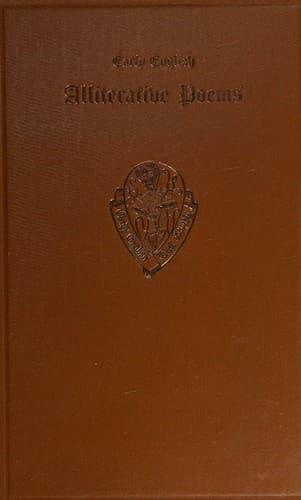
Early English Alliterative Poems: in the West-Midland Dialect of the Fourteenth Century — John Shaqi
Early English Alliterative Poems: in the West-Midland Dialect of the Fourteenth Century
Religion
Early English Alliterative Poems: in the West-Midland Dialect of the Fourteenth Century
English poetry -- Middle English, 1100-1500
[Sidenote: [Fol. 45a.]]
[Sidenote: The maiden addresses the Virgin. She then explains
to her father that each has his place in heaven.]
“Cortayse quen” þe{n}ne s[a]yde þat gaye,
Knelande to grou{n}de, folde vp hyr face,
“Makeleȝ moder & myryest may,
Blessed bygy{n}ner[16] of vch a grace!” 436
Þe{n}ne ros ho vp & con restay,
& speke me towarde i{n} þat space:
“S{ir} fele here porchaseȝ & fongeȝ pray
Bot supplantoreȝ none w{i}t{h}-i{n}ne þys place; 440
Þat emp{er}ise al heue{n}ȝ hatȝ,
& vrþe & helle i{n} her bayly;
Of erytage ȝet non wyl ho chace,
For ho is quen of cortaysye. 444
[Sidenote 16: MS. reads _bȳgyner_.]
[Sidenote: The court of God has a property in its own being.
Each one in it is a king or queen. The mother of Christ holds
the chief place.]
The co{ur}t of þe kyndom of god alyue,
Hatȝ a p{ro}perty i{n} hyt self bey{n}g;
Alle þat may þer-i{n}ne aryue
Of alle þe reme is quen oþ{er} ky{n}g, 448
& neu{er} oþ{er} ȝet schal depryue,
Bot vchon fayn of oþ{er}eȝ hafy{n}g,
& wolde her corou{n}eȝ wern worþe þo fyue,
If possyble were her mendy{n}g. 452
Bot my lady of quom Iesu con spry{n}g,
Ho haldeȝ þe empyre ou{er} v{us} ful hyȝe,
& þat dyspleseȝ non of oure gy{n}g,
For ho is quene of cortaysye. 456
[Sidenote: We are all members of Christ’s body. Look that
each limb be perfect.]
Of co{ur}taysye, as saytȝ say{n}t poule,
Al arn we me{m}breȝ of ih{es}u kryst,
As heued & arme & legg & naule,
Temen to hys body ful trwe & t[r]yste; 460
Ryȝt so is vch a krysten sawle,
A longande lym to þe mayster of myste;
Þe{n}ne loke what hate oþ{er} any gawle,
Is tached oþ{er} tyȝed þy ly{m}meȝ by-twyste, 464
Þy heued hatȝ nauþer greme ne gryste,
On arme oþ{er} fynger, þaȝ þ{o}u ber byȝe;
So fare we alle wyth luf & lyste,
To ky{n}g & quene by cortaysye.” 468
[Sidenote: [Fol. 45b.]]
[Sidenote: The father replies that he cannot understand how
his pearl can be a queen. He desires to know what greater
honour she can have.]
“Cortayse,” q{uod} I, “I leue
& charyte grete be yow amo{n}g,
Bot my speche þat yow ne greue,
. . . . . 472
Þy self in heuen ou{er} hyȝ þ{o}u heue,
To make þe quen þat watȝ so ȝonge,
What more-hond moȝte he acheue
Þat hade endured i{n} worlde stronge, 476
& lyued i{n} penau{n}ce hys lyueȝ longe,
W{i}t{h} bodyly bale hy{m} blysse to byye?
What more worschyp moȝt ho fonge,
Þen corou{n}de be ky{n}g by cortayse? 480
[Headnote: THE PARABLE OF THE LABOURERS IN THE VINEYARD.]
IX.
Public-domain text, read in full here on John Shaqi.
Reviews
Reviews
No reviews yet
Be the first to share your thoughts on this work.
Join the Discussion
Join the discussion
Sign in to leave a comment or review.
Sign InorCreate an account