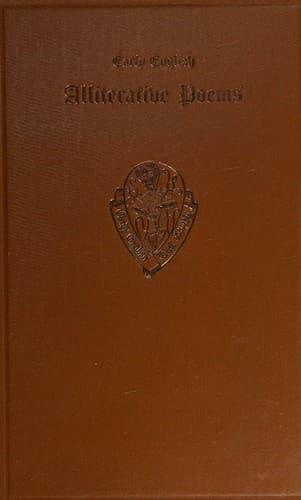
Early English Alliterative Poems: in the West-Midland Dialect of the Fourteenth Century
Religion
Early English Alliterative Poems: in the West-Midland Dialect of the Fourteenth Century
English poetry -- Middle English, 1100-1500
[Sidenote: She was only two years old when she died,
and could do nothing to please God. She might be a countess
or some great lady but not a queen.]
That cortayse is to fre of dede,
Ȝyf hyt be soth þat þ{o}u coneȝ saye,
Þ{o}u lyfed not two ȝer i{n} oure þede,
Þ{o}u cowþeȝ neu{er} god nauþ{er} plese ne pray, 484
Ne neu{er} nawþer pater ne crede,
& quen mad on þe fyrst day!
I may not traw, so god me spede,
Þat god wolde wryþe so wrange away; 488
Of cou{n}tes damysel, par ma fay,
Wer fayr i{n} heuen to halde asstate
Aþ{er} elleȝ a lady of lasse aray,
Bot a quene, hit is to dere a date.” 492
[Sidenote: The maiden informs her father that there is no limit
to God’s power. The parable of the labourers in the vineyard.]
“Þer is no date of hys god-nesse,”
Þen sayde to me þat worþy wyȝte,
“For al is trawþe þat he con dresse,
& he may do no þynk bot ryȝt, 496
As mathew meleȝ i{n} yo{ur} messe,
I{n} sothfol gospel of god al-myȝt
I{n} sample he can ful grayþely gesse,
& lykneȝ hit to heuen lyȝte.” 500
“My regne, he saytȝ, is lyk on hyȝt,
To a lorde þat hade a uyne I wate,
Of tyme of ȝere þe terme watȝ tyȝt,
To labor vyne watȝ dere þe date, 504
[Sidenote: [Fol. 46a.]]
[Sidenote: The lord of the vineyard hires workmen for a penny a
day. At noon the lord hires other men standing idle in the
market place.]
Þat date of ȝere wel knawe þys hyne;
Þe lorde ful erly vp he ros,
To hyre werkmen to hys vyne,
& fyndeȝ þ{er} su{m}me to hys porpos, 508
Into acorde þay con de-clyne,
For a pené on a day & forth þay gotȝ,
Wryþen & worchen & don gret pyne,
Keruen & caggen & man hit clos; 512
Aboute vnder, þe lorde to marked totȝ
& ydel men stande he fyndeȝ þer-ate,
“Why stande ȝe ydel” he sayde to þos,
Ne knawe ȝe of þis day no date? 516
[Sidenote: He commands them to go into his vineyard, and he will
give them what is right.]
“Er date of daye hider arn we won{n}e,”
So watȝ al samen her answar soȝt;
“We haf standen her syn ros þe su{n}ne,
& no mo{n} byddeȝ v{us} do, ryȝt noȝt.” 520
“Gos i{n}-to my vyne, dotȝ þat ȝe co{n}ne.”
So sayde þe lorde & made hit toȝt.
“What resonabele hyre be naȝt be ru{n}ne,
I yow pray i{n} dede & þoȝte.” 524
Þay wente i{n} to þe vyne & wroȝte,
& al day þe lorde þ{us} ȝede his gate,
& nw men to hys vyne he broȝte;
Wel neȝ wyl day watȝ passed date, 528
Public-domain text, read in full here on John Shaqi.
Reviews
Reviews
No reviews yet
Be the first to share your thoughts on this work.
Join the Discussion
Join the discussion
Sign in to leave a comment or review.
Sign InorCreate an account