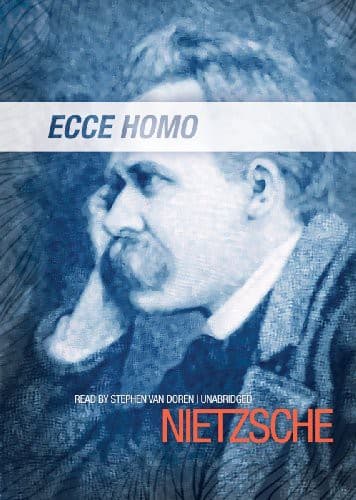
Ecce Homo: Complete Works, Volume Seventeen — John Shaqi
Ecce Homo: Complete Works, Volume SeventeenNietzsche, Friedrich Wilhelm
PhilosophyPhilosophy
Ecce Homo: Complete Works, Volume Seventeen
Nietzsche, Friedrich Wilhelm
Nietzsche, Friedrich Wilhelm, 1844-1900; Philosophers -- Germany -- Biography
ECCE HOMO
(_NIETZSCHES AUTOBIOGRAPHY_)
BY
FRIEDRICH NIETZSCHE
TRANSLATED BY
ANTHONY M. LUDOVICI
POETRY RENDERED BY
PAUL V. COHN -- FRANCIS BICKLEY
HERMAN SCHEFFAUER -- DR. G. T. WRENCH
HYMN TO LIFE (_composed by F. NIETZSCHE_)
The Complete Works of Friedrich Nietzsche
The First Complete and Authorised English Translation
Edited by Dr Oscar Levy
Volume Seventeen
T.N. FOULIS
13 & 15 FREDERICK STREET
EDINBURGH: AND LONDON
1911
CONTENTS
TRANSLATOR'S INTRODUCTION
AUTHOR'S PREFACE
WHY I AM SO WISE
WHY I AM SO CLEVER
WHY I WRITE SUCH EXCELLENT BOOKS
The Birth of Tragedy
Thoughts out of Season
Human, All-too-Human
The Dawn of Day
The Joyful Wisdom
Thus spake Zarathustra
Beyond Good and Evil
The Genealogy of Morals
The Twilight of the Idols
The Case of Wagner
WHY I AM A FATALITY
EDITORIAL NOTE TO POETRY
POETRY--
Songs, Epigrams, etc.
Dionysus-Dithyrambs
Fragments of Dionysus-Dithyrambs
HYMN TO LIFE, COMPOSED BY F. NIETZSCHE
TRANSLATOR'S INTRODUCTION
_Ecce Homo_ is the last prose work that Nietzsche wrote. It is true
that the pamphlet _Nietzsche contra Wagner_ was prepared a month
later than the Autobiography; but we cannot consider this pamphlet as
anything more than a compilation, seeing that it consists entirely of
aphorisms drawn from such previous works as _Joyful Wisdom, Beyond
Good and Evil, The Genealogy of Morals,_ etc. Coming at the end of a
year in which he had produced the _Case of Wagner, The Twilight of the
Idols,_ and _The Antichrist, Ecce Homo_ is not only a coping-stone
worthy of the wonderful creations of that year, but also a fitting
conclusion to his whole life, in the form of a grand summing up of his
character as a man, his purpose as a reformer, and his achievement
as a thinker. As if half conscious of his approaching spiritual end,
Nietzsche here bids his friends farewell, just in the manner in which,
in the _Twilight of the Idols_ (Aph. 36, Part ix.), he declares that
every one should be able to take leave of his circle of relatives and
intimates when his time seems to have come--that is to say, while he
is still _himself_ while he still knows what he is about, and is able
to measure his own life and life in general, and speak of both in a
manner which is not vouchsafed to the groaning invalid, to the man
lying on his back, decrepit and exhausted, or to the moribund victim
of some wasting disease. Nietzsche's spiritual death, like his whole
life, was in singular harmony with his doctrine: he died suddenly
and proudly,--sword in hand. War, which he--and he alone among all
the philosophers of Christendom--had praised so whole-heartedly, at
last struck him down in the full vigour of his manhood, and left him
a victim on the battlefield--the terrible battlefield of thought, on
which there is no quarter, and for which no Geneva Convention has yet
been established or even thought of.
Public-domain text, read in full here on John Shaqi.
Reviews
Reviews
No reviews yet
Be the first to share your thoughts on this work.
Join the Discussion
Join the discussion
Sign in to leave a comment or review.
Sign InorCreate an account