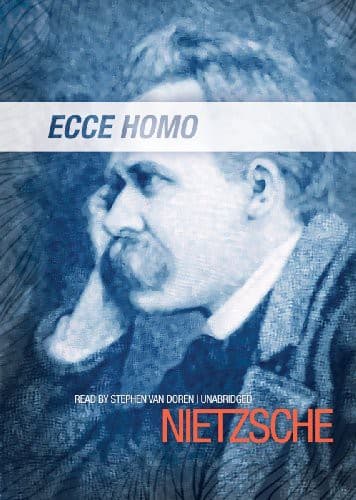
Ecce Homo: Complete Works, Volume SeventeenNietzsche, Friedrich Wilhelm
PhilosophyPhilosophy
Ecce Homo: Complete Works, Volume Seventeen
Nietzsche, Friedrich Wilhelm
Nietzsche, Friedrich Wilhelm, 1844-1900; Philosophers -- Germany -- Biography
stomach trouble, however much I may have suffered from profound
weakness of the gastric system as the result of general exhaustion.
Even my eye trouble, which sometimes approached so parlously near
to blindness, was only an effect and not a cause; for, whenever my
general vital condition improved, my power of vision also increased.
Having admitted all this, do I need to say that I am experienced in
questions of decadence? I know them inside and out. Even that filigree
art of prehension and comprehension in general, that feeling for
delicate shades of difference, that psychology of "seeing through brick
walls," and whatever else I may be able to do, was first learnt then,
and is the specific gift of that period during which everything in
me was subtilised,--observation itself, together with all the organs
of observation. To look upon healthier concepts and values from the
standpoint of the sick, and conversely to look down upon the secret
work of the instincts of decadence from the standpoint of him who is
laden and self-reliant with the richness of life--this has been my
longest exercise, my principal experience. If in anything at all, it
was in this that I became a master. To-day my hand knows the trick, I
now have the knack of reversing perspectives: the first reason perhaps
why a _Transvaluation of all Values_ has been possible to me alone.
2
For, apart from the fact that I am a decadent, I am also the reverse of
such a creature. Among other things my proof of this is, that I always
instinctively select the proper remedy when my spiritual or bodily
health is low; whereas the decadent, as such, invariably chooses those
remedies which are bad for him. As a whole I was sound, but in certain
details I was a decadent. That energy with which I sentenced myself
to absolute solitude, and to a severance from all those conditions in
life to which I had grown accustomed; my discipline of myself, and my
refusal to allow myself to be pampered, to be tended hand and foot, and
to be doctored--all this betrays the absolute certainty of my instincts
respecting what at that time was most needful to me. I placed myself
in my own hands, I restored myself to health: the first condition of
success in such an undertaking, as every physiologist will admit, is
that at bottom a man should be sound. An intrinsically morbid nature
cannot become healthy. On the other hand, to an intrinsically sound
nature, illness may even constitute a powerful stimulus to life, to
a surplus of life. It is in this light that I now regard the long
period of illness that I endured: it seemed as if I had discovered
life afresh, my own self included. I tasted all good things and even
trifles in a way in which it was not easy for others to taste them--out
of my Will to Health and to Life I made my philosophy.... For this
should be thoroughly understood; it was during those years in which my
vitality reached its lowest point that I ceased from being a pessimist:
Public-domain text, read in full here on John Shaqi.
Reviews
Reviews
No reviews yet
Be the first to share your thoughts on this work.
Join the Discussion
Join the discussion
Sign in to leave a comment or review.
Sign InorCreate an account