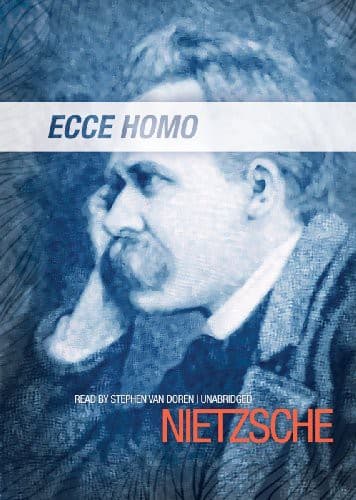
Ecce Homo: Complete Works, Volume SeventeenNietzsche, Friedrich Wilhelm
PhilosophyPhilosophy
Ecce Homo: Complete Works, Volume Seventeen
Nietzsche, Friedrich Wilhelm
Nietzsche, Friedrich Wilhelm, 1844-1900; Philosophers -- Germany -- Biography
the instinct of self-recovery forbade my holding to a philosophy of
poverty and desperation. Now, by what signs are Nature's lucky strokes
recognised among men? They are recognised by the fact that any such
lucky stroke gladdens our senses; that he is carved from one integral
block, which is hard, sweet, and fragrant as well. He enjoys that only
which is good for him; his pleasure, his desire, ceases when the limits
of that which is good for him are overstepped. He divines remedies for
injuries; he knows how to turn serious accidents to his own advantage;
that which does not kill him makes him stronger. He instinctively
gathers his material from all he sees, hears, and experiences. He is a
selective principle; he rejects much. He is always in his own company,
whether his intercourse be with books, with men, or with natural
scenery; he honours the things he chooses, the things he acknowledges,
the things he trusts. He reacts slowly to all kinds of stimuli, with
that tardiness which long caution and deliberate pride have bred in
him--he tests the approaching stimulus; he would not dream of meeting
it half-way. He believes neither in "ill-luck" nor "guilt"; he can
digest himself and others; he knows how to forget--he is strong enough
to make everything turn to his own advantage.
Lo then! I am the very reverse of a decadent, for he whom I have just
described is none other than myself.
3
This double thread of experiences, this means of access to two worlds
that seem so far asunder, finds in every detail its counterpart in my
own nature--I am my own complement: I have a "second" sight, as well
as a first. And perhaps I also have a third sight. By the very nature
of my origin I was allowed an outlook beyond all merely local, merely
national and limited horizons; it required no effort on my part to be
a "good European." On the other hand, I am perhaps more German than
modern Germans--mere Imperial Germans--can hope to be,--I, the last
anti-political German. Be this as it may, my ancestors were Polish
noblemen: it is owing to them that I have so much race instinct in my
blood--who knows? perhaps even the _liberum veto_[1] When I think of
the number of times in my travels that I have been accosted as a Pole,
even by Poles themselves, and how seldom I have been taken for a German,
it seems to me as if I belonged to those only who have a sprinkling
of German in them. But my mother, Franziska Oehler, is at any rate
something very German; as is also my paternal grandmother, Erdmuthe
Krause. The latter spent the whole of her youth in good old Weimar,
not without coming into contact with Goethe's circle. Her brother,
Krause, the Professor of Theology in Königsberg, was called to the
post of General Superintendent at Weimar after Herder's death. It is
not unlikely that her mother, my great grandmother, is mentioned in
young Goethe's diary under the name of "Muthgen." She married twice,
and her second husband was Superintendent Nietzsche of Eilenburg.
Public-domain text, read in full here on John Shaqi.
Reviews
Reviews
No reviews yet
Be the first to share your thoughts on this work.
Join the Discussion
Join the discussion
Sign in to leave a comment or review.
Sign InorCreate an account