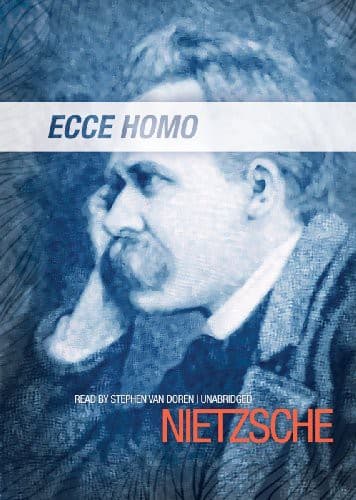
Ecce Homo: Complete Works, Volume Seventeen — John Shaqi
Ecce Homo: Complete Works, Volume SeventeenNietzsche, Friedrich Wilhelm
PhilosophyPhilosophy
Ecce Homo: Complete Works, Volume Seventeen
Nietzsche, Friedrich Wilhelm
Nietzsche, Friedrich Wilhelm, 1844-1900; Philosophers -- Germany -- Biography
Freedom from resentment and the understanding of the nature of
resentment--who knows how very much after all I am indebted to my long
illness for these two things? The problem is not exactly simple: a
man must have experienced both through his strength and through his
weakness, If illness and weakness are to be charged with anything at
all, it is with the fact that when they prevail, the very instinct of
recovery, which is the instinct of defence and of war in man, becomes
decayed. He knows not how to get rid of anything, how to come to
terms with anything, and how to cast anything behind him. Everything
wounds him. People and things draw importunately near, all experiences
strike deep, memory is a gathering wound. To be ill is a sort of
resentment in itself. Against this resentment the invalid has only
one great remedy--I call it _Russian fatalism,_ that fatalism which
is free from revolt, and with which the Russian soldier, to whom a
campaign proves unbearable, ultimately lays himself down in the snow.
To accept nothing more, to undertake nothing more, to absorb nothing
more--to cease entirely from reacting.... The tremendous sagacity
of this fatalism, which does not always imply merely the courage for
death, but which in the most dangerous cases may actually constitute
a self-preservative measure, amounts to a reduction of activity in
the vital functions, the slackening down of which is like a sort of
will to hibernate. A few steps farther in this direction we find the
fakir, who will sleep for weeks in a tomb.... Owing to the fact that
one would be used up too quickly if one reacted, one no longer reacts
at all: this is the principle. And nothing on earth consumes a man
more quickly than the passion of resentment. Mortification, morbid
susceptibility, the inability to wreak revenge, the desire and thirst
for revenge, the concoction of every sort of poison--this is surely the
most injurious manner of reacting which could possibly be conceived by
exhausted men. It involves a rapid wasting away of nervous energy, an
abnormal increase of detrimental secretions, as, for instance, that
of bile into the stomach. To the sick man resentment ought to be more
strictly forbidden than anything else--it is _his_ special danger:
unfortunately, however, it is also his most natural propensity. This
was fully grasped by that profound physiologist Buddha. His "religion,"
which it would be better to call a system of hygiene, in order to avoid
confounding it with a creed so wretched as Christianity, depended
for its effect upon the triumph over resentment: to make the soul
free therefrom was considered the first step towards recovery. "Not
through hostility is hostility put to flight; through friendship does
hostility end": this stands at the beginning of Buddha's teaching--this
is not a precept of morality, but of physiology. Resentment born of
weakness is not more deleterious to anybody than it is to the weak
Public-domain text, read in full here on John Shaqi.
Reviews
Reviews
No reviews yet
Be the first to share your thoughts on this work.
Join the Discussion
Join the discussion
Sign in to leave a comment or review.
Sign InorCreate an account