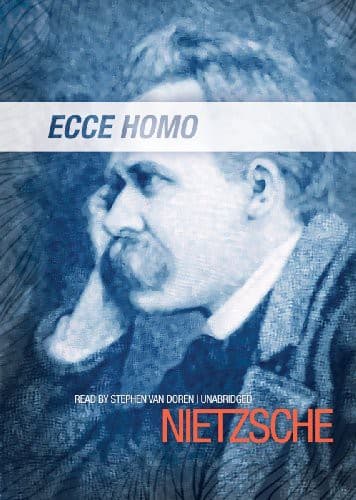
Ecce Homo: Complete Works, Volume SeventeenNietzsche, Friedrich Wilhelm
PhilosophyPhilosophy
Ecce Homo: Complete Works, Volume Seventeen
Nietzsche, Friedrich Wilhelm
Nietzsche, Friedrich Wilhelm, 1844-1900; Philosophers -- Germany -- Biography
It was Heinrich Heine who gave me the most perfect idea of what a
lyrical poet could be. In vain do I search through all the kingdoms of
antiquity or of modern times for anything to resemble his sweet and
passionate music. He possessed that divine wickedness, without which
perfection itself becomes unthinkable to me,--I estimate the value of
men, of races, according to the extent to which they are unable to
conceive of a god who has not a dash of the satyr in him. And with
what mastery he wields his native tongue! One day it will be said of
Heine and me that we were by far the greatest artists of the German
language that have ever existed, and that we left all the efforts that
mere Germans made in this language an incalculable distance behind
us. I must be profoundly related to Byron's _Manfred:_ of all the
dark abysses in this work I found the counterparts in my own soul--at
the age of thirteen I was ripe for this book. Words fail me, I have
only a look, for those who dare to utter the name of _Faust_ in the
presence of _Manfred._ The Germans are _incapable_ of conceiving
anything sublime: for a proof of this, look at Schumann! Out of anger
for this mawkish Saxon, I once deliberately composed a counter-overture
to _Manfred,_ of which Hans von Bülow declared he had never seen the
like before on paper: such compositions amounted to a violation of
Euterpe. When I cast about me for my highest formula of Shakespeare,
I find invariably but this one: that he conceived the type of Cæsar.
Such things a man cannot guess--he either is the thing, or he is not.
The great poet draws his creations only from out of his own reality.
This is so to such an extent, that often after a lapse of time he
can no longer endure his own work.... After casting a glance between
the pages of my _Zarathustra,_ I pace my room to and fro for half
an hour at a time, unable to overcome an insufferable fit of tears.
I know of no more heartrending reading than Shakespeare: how a man
must have suffered to be so much in need of playing the clown! Is
Hamlet _understood_? It is not doubt, but certitude that drives one
mad.... But in order to feel this, one must be profound, one must be
an abyss, a philosopher.... We all fear the truth.... And, to make a
confession; I feel instinctively certain and convinced that Lord Bacon
is the originator, the self-torturer, of this most sinister kind of
literature: what do I care about the miserable gabble of American
muddlers and blockheads? But the power for the greatest realism in
vision is not only compatible with the greatest realism in deeds,
with the monstrous in deeds, with crime--_it actually presupposes the
latter._ ... We do not know half enough about Lord Bacon--the first
realist in all the highest acceptation of this word--to be sure of
everything he did, everything he willed, and everything he experienced
in his inmost soul.... Let the critics go to hell! Suppose I had
Public-domain text, read in full here on John Shaqi.
Reviews
Reviews
No reviews yet
Be the first to share your thoughts on this work.
Join the Discussion
Join the discussion
Sign in to leave a comment or review.
Sign InorCreate an account