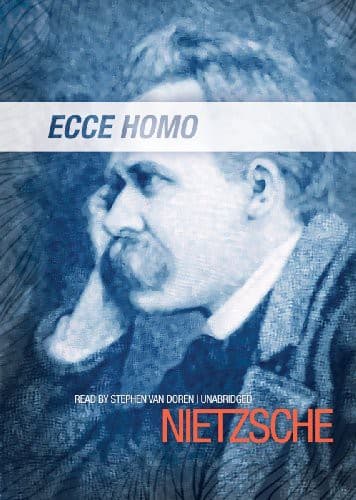
Ecce Homo: Complete Works, Volume Seventeen — John Shaqi
Ecce Homo: Complete Works, Volume SeventeenNietzsche, Friedrich Wilhelm
PhilosophyPhilosophy
Ecce Homo: Complete Works, Volume Seventeen
Nietzsche, Friedrich Wilhelm
Nietzsche, Friedrich Wilhelm, 1844-1900; Philosophers -- Germany -- Biography
christened my _Zarathustra_ with a name not my own,--let us say with
Richard Wagner's name,--the acumen of two thousand years would not have
sufficed to guess that the author of _Human, all-too-Human_ was the
visionary of _Zarathustra._
5
As I am speaking here of the recreations of my life, I feel I must
express a word or two of gratitude for that which has refreshed me by
far the most heartily and most profoundly. This, without the slightest
doubt, was my intimate relationship with Richard Wagner. All my other
relationships with men I treat quite lightly; but I would not have the
days I spent at Tribschen--those days of confidence, of cheerfulness,
of sublime flashes, and of profound moments--blotted from my life
at any price. I know not what Wagner may have been for others; but
no cloud ever darkened _our_ sky. And this brings me back again to
France,--I have no arguments against Wagnerites, and _hoc genus omne_
who believe that they do honour to Wagner by believing him to be
like themselves; for such people I have only a contemptuous curl of
my lip. With a nature like mine, which is so strange to everything
Teutonic, that even the presence of a German retards my digestion, my
first meeting with Wagner was the first moment in my life in which I
breathed freely: I felt him, I honoured him, as a foreigner, as the
opposite and the incarnate contradiction of all "German virtues." We
who as children breathed the marshy atmosphere of the fifties, are
necessarily pessimists in regard to the concept "German"; we cannot
be anything else than revolutionaries--we can assent to no state of
affairs which allows the canting bigot to be at the top. I care not
a jot whether this canting bigot acts in different colours to-day,
whether he dresses in scarlet or dons the uniform of a hussar.[2] Very
well, then! Wagner was a revolutionary--he fled from the Germans....
As an artist, a man has no home in Europe save in Paris; that subtlety
of all the five senses which Wagner's art presupposes, those fingers
that can detect slight gradations, psychological morbidity--all these
things can be found only in Paris. Nowhere else can you meet with
this passion for questions of form, this earnestness in matters of
_mise-en-scène,_ which is the Parisian earnestness _par excellence._
In Germany no one has any idea of the tremendous ambition that fills
the heart of a Parisian artist. The German is a good fellow. Wagner was
by no means a good fellow.... But I have already said quite enough
on the subject of Wagner's real nature (see _Beyond Good and Evil,_
Aphorism 269), and about those to whom he is most closely related.
He is one of the late French romanticists, that high-soaring and
heaven-aspiring band of artists, like Delacroix and Berlioz, who in
their inmost nacres are sick and incurable, and who are all fanatics
of _expression,_ and virtuosos through and through.... Who, in sooth,
was the first intelligent follower of Wagner? Charles Baudelaire, the
Public-domain text, read in full here on John Shaqi.
Reviews
Reviews
No reviews yet
Be the first to share your thoughts on this work.
Join the Discussion
Join the discussion
Sign in to leave a comment or review.
Sign InorCreate an account