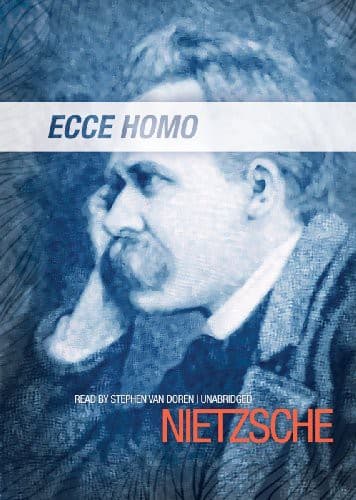
Ecce Homo: Complete Works, Volume SeventeenNietzsche, Friedrich Wilhelm
PhilosophyPhilosophy
Ecce Homo: Complete Works, Volume Seventeen
Nietzsche, Friedrich Wilhelm
Nietzsche, Friedrich Wilhelm, 1844-1900; Philosophers -- Germany -- Biography
I know of no other manner of dealing
with great tasks, than as _play_: this, as a sign of greatness, is
an essential prerequisite. The slightest constraint, a sombre mien,
any hard accent in the voice--all these things are objections to a
man, but how much more to his work!... One must not have nerves....
Even to _suffer_ from solitude is an objection--the only thing I have
always suffered from is "multitude."[5] At an absurdly tender age, in
fact when I was seven years old, I already knew that no human speech
would ever reach me: did any one ever see me sad on that account? At
present I still possess the same affability towards everybody, I am
even full of consideration for the lowest: in all this there is not
an atom of haughtiness or of secret contempt. He whom I despise soon
guesses that he is despised by me: the very fact of my existence is
enough to rouse indignation in all those who have polluted blood in
their veins. My formula for greatness in man is! _amor fati_: the fact
that a man wishes nothing to be different, either in front of him or
behind him, or for all eternity. Not only must the necessary be borne,
and on no account concealed,--all idealism is falsehood in the face of
necessity,--but it must also be _loved...._
[Footnote 1: Nietzsche, as is well known, devoted much time when a
student at Leipzig to the study of three Greek philosophers, Theognis,
Diogenes Laertius, and Democritus. This study first bore fruit in the
case of a paper, _Zur Geschichte der Theognideischen Spruchsammlung_,
which was subsequently published by the most influential journal of
classical philology in Germany. Later, however, it enabled Nietzsche to
enter for the prize offered by the University of Leipzig for an essay,
_De fontibus Diogenis Laertii._ He was successful in gaining the prize,
and the treatise was afterwards published in the _Rheinisches Museum,_
and is still quoted as an authority. It is to this essay, written when
he was twenty-three years of age, that he here refers.--TR.]
[Footnote 2: The favourite uniform of the German Emperor, William
II.--TR.]
[Footnote 3: In the latter years of his life, Nietzsche practically
made Italy his home.--TR.]
[Footnote 4: See note on page 37.]
[Footnote 5: The German words are, _Einsamkeit_ and _Vielsamkeit._ The
latter was coined by Nietzsche. The English word "multitude" should,
therefore, be understood as signifying multifarious instincts and
gifts, which in Nietzsche strove for ascendancy and caused him more
suffering than any solitude. Complexity of this sort, held in check
by a dominant instinct, as in Nietzsche's case, is of course the only
possible basis of an artistic nature.--TR.]
WHY I WRITE SUCH EXCELLENT BOOKS
1
Public-domain text, read in full here on John Shaqi.
Reviews
Reviews
No reviews yet
Be the first to share your thoughts on this work.
Join the Discussion
Join the discussion
Sign in to leave a comment or review.
Sign InorCreate an account