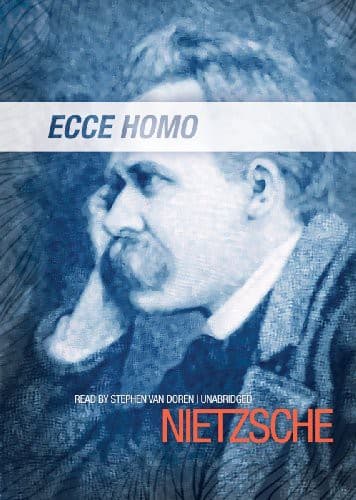
Ecce Homo: Complete Works, Volume SeventeenNietzsche, Friedrich Wilhelm
PhilosophyPhilosophy
Ecce Homo: Complete Works, Volume Seventeen
Nietzsche, Friedrich Wilhelm
Nietzsche, Friedrich Wilhelm, 1844-1900; Philosophers -- Germany -- Biography
I am one thing, my creations are another. Here, before I speak of the
books themselves, I shall touch upon the question of the understanding
and misunderstanding with which they have met. I shall proceed to
do this in as perfunctory a manner as the occasion demands; for the
time has by no means come for this question. My time has not yet
come either; some are born posthumously. One s day institutions will
be needed in which men will live and teach, as I understand living
and teaching; maybe, also, that by that time, chairs will be founded
and endowed for the interpretation of _Zarathustra. _ But I should
regard it as a complete contradiction of myself, if I expected to
find ears and eyes for my truths to-day: the fact that no one listens
to me, that no one knows how to receive at my hands to-day, is not
only comprehensible, it seems to me quite the proper thing. I do not
wish to be mistaken for another--and to this end I must not mistake
myself. To repeat what I have already said, I can point to but few
instances of ill-will in my life: and as for literary ill-will, I
could mention scarcely a single example of it. On the other hand, I
have met with far too much _pure foolery_!... It seems to me that to
take up one of my books is one of the rarest honours that a man can
pay himself--even supposing that he put his shoes from off his feet
beforehand, not to mention boots.... When on one occasion Dr. Heinrich
von Stein honestly complained that he could not understand a word of
my _Zarathustra,_ I said to him that this was just as it should be: to
have understood six sentences in that book--that is to say, to have
lived them--raises a man to a higher level among mortals than "modern"
men can attain. With this feeling of distance how could I even wish to
be read by the "moderns" whom I know! My triumph is just the opposite
of what Schopenhauer's was--I say "_Non_ legor, _non_ legar."--Not
that I should like to underestimate the pleasure I have derived from
the innocence with which my works have frequently been contradicted.
As late as last summer, at a time when I was attempting, perhaps by
means of my weighty, all-too-weighty literature, to throw the rest of
literature off its balance, a certain professor of Berlin University
kindly gave me to understand that I ought really to make use of a
different form: no one could read such stuff as I wrote.--Finally, it
was not Germany, but Switzerland that presented me with the two most
extreme cases. An essay on _Beyond Good and Evil,_ by Dr. V. Widmann in
the paper called the _Bund,_ under the heading "Nietzsche's Dangerous
Book," and a general account of all my works, from the pen of Herr
Karl Spitteler, also in the _Bund,_ constitute a maximum in my life--I
shall not say of what.... The latter treated my _Zarathustra,_ for
instance as "_advanced exercises in style_," and expressed the wish
that later on I might try and attend to the question of substance as
well; Dr.
Public-domain text, read in full here on John Shaqi.
Ecce Homo: Complete Works, Volume Seventeen — John Shaqi
Reviews
Reviews
No reviews yet
Be the first to share your thoughts on this work.
Join the Discussion
Join the discussion
Sign in to leave a comment or review.
Sign InorCreate an account