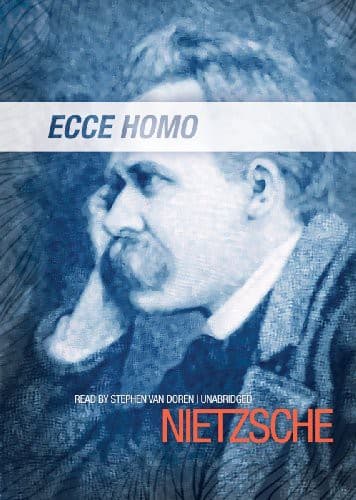
Ecce Homo: Complete Works, Volume SeventeenNietzsche, Friedrich Wilhelm
PhilosophyPhilosophy
Ecce Homo: Complete Works, Volume Seventeen
Nietzsche, Friedrich Wilhelm
Nietzsche, Friedrich Wilhelm, 1844-1900; Philosophers -- Germany -- Biography
Widmann assured me of his respect for the courage I showed
in endeavouring to abolish all decent feeling. Thanks to a little
trick of destiny, every sentence in these criticisms seemed, with
a consistency that I could but admire, to be an inverted truth. In
fact it was most remarkable that all one had to do was to "transvalue
all values," in order to hit the nail on the head with regard to me,
instead of striking my head with the nail.... I am more particularly
anxious therefore to discover an explanation. After all, no one can
draw more out of things, books included, than he already knows. A man
has no ears for that to which experience has given him no access. To
take an extreme case, suppose a book contains simply incidents which
lie quite outside the range of general or even rare experience--suppose
it to be the _first_ language to express a whole series of experiences.
In this case nothing it contains will really be heard at all, and,
thanks to an acoustic delusion, people will believe that where nothing
is heard there is nothing to hear.... This, at least, has been my
usual experience, and proves, if you will, the originality of my
experience. He who thought he had understood something in my work, had
as a rule adjusted something in it to his own image--not infrequently
the very opposite of myself, an "idealist," for instance. He who
understood nothing in my work, would deny that I was worth considering
at all.--The word "Superman," which designates a type of man that
would be one of nature's rarest and luckiest strokes, as opposed to
"modern" men, to "good" men, to Christians and other Nihilists,--a
word which in the mouth of Zarathustra, the annihilator of morality,
acquires a very profound meaning,--is understood almost everywhere, and
with perfect innocence, in the light of those values to which a flat
contradiction was made manifest in the figure of Zarathustra--that is
to say, as an "ideal" type, a higher kind of man, half "saint" and half
"genius." ... Other learned cattle have suspected me of Darwinism on
account of this word: even the "hero cult" of that great unconscious
and involuntary swindler, Carlyle,--a cult which I repudiated with
such roguish malice,--was recognised in my doctrine. Once, when I
whispered to a man that he would do better I to seek for the Superman
in a Cæsar Borgia than in a Parsifal, he could not believe his ears.
The fact that I am quite free from curiosity in regard to criticisms of
my books, more particularly when they appear in newspapers, will have
to be forgiven me. My friends and my publishers know this, and never
speak to me of such things. In one particular case, I once saw all the
sins that had been committed against a single book--it was _Beyond Good
and Evil;_ I could tell you a nice story about it. Is it possible that
the _National-Zeitung_--a Prussian paper (this comment is for the sake
of my foreign readers--for my own part, I beg to state, I read only _Le
Public-domain text, read in full here on John Shaqi.
Reviews
Reviews
No reviews yet
Be the first to share your thoughts on this work.
Join the Discussion
Join the discussion
Sign in to leave a comment or review.
Sign InorCreate an account