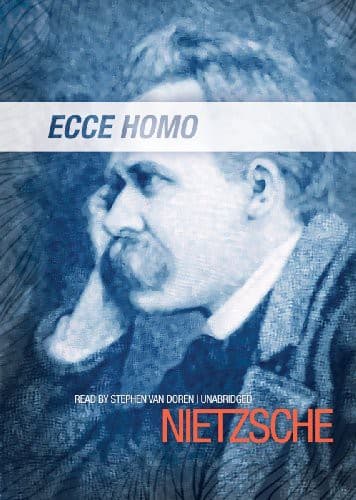
Ecce Homo: Complete Works, Volume SeventeenNietzsche, Friedrich Wilhelm
PhilosophyPhilosophy
Ecce Homo: Complete Works, Volume Seventeen
Nietzsche, Friedrich Wilhelm
Nietzsche, Friedrich Wilhelm, 1844-1900; Philosophers -- Germany -- Biography
necessary to the weak inspired by weakness.... These people are not
at liberty to "know,"--decadents stand in need of lies,--it is one of
their self-preservative measures. He who not only understands the word
"Dionysian," but understands _himself_ in that term, does not require
any refutation of Plato, or of Christianity, or of Schopenhauer--for
his nose _scents decomposition._
3
The extent to which I had by means of these doctrines discovered the
idea of "tragedy," the ultimate explanation of what the psychology of
tragedy is, I discussed finally in _The Twilight of the Idols_ (Aph.
5, part 10).... "The saying of yea to life, and even to its weirdest
and most difficult problems: the will to life rejoicing at its own
infinite vitality in the sacrifice of its highest types--that is what I
called Dionysian, that is what I meant as the bridge to the psychology
of the tragic poet. Not to cast out terror and pity, or to purge one's
self of dangerous passion by discharging it with vehemence,--this was
Aristotle's[2] misunderstanding of it,--but to be far beyond terror
and pity and to be the eternal lust of Becoming itself--that lust
which also involves the joy of destruction." ... In this sense I have
the right to regard myself as the first _tragic philosopher_--that is
to say, the most extreme antithesis and antipodes of a pessimistic
philosopher. Before my time no such thing existed as this translation
of the Dionysian phenomenon into philosophic emotion: tragic wisdom was
lacking; in vain have I sought for signs of it even among the great
Greeks in philosophy--those belonging to the two centuries before
Socrates. I still remained a little doubtful about Heraclitus, in whose
presence, alone, I felt warmer and more at ease than anywhere else.
The yea-saying to the impermanence and annihilation of things, which
is the decisive feature of a Dionysian philosophy; the yea-saying to
contradiction and war, the postulation of Becoming, together with the
radical rejection even of the concept _Being_-- in all these things, at
all events, I must recognise him who has come nearest to me in thought
hither to. The doctrine of the "Eternal Recurrence"--that is to say,
of the absolute and eternal repetition of all things in periodical
cycles--this doctrine of Zarathustra's might, it is true, have been
taught before. In any case, the Stoics, who derived nearly all their
fundamental ideas from Heraclitus, show traces of it.
Public-domain text, read in full here on John Shaqi.
Reviews
Reviews
No reviews yet
Be the first to share your thoughts on this work.
Join the Discussion
Join the discussion
Sign in to leave a comment or review.
Sign InorCreate an account