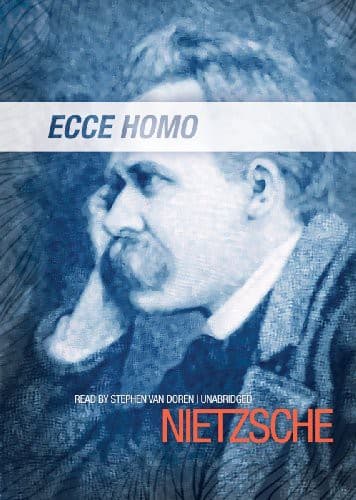
Ecce Homo: Complete Works, Volume SeventeenNietzsche, Friedrich Wilhelm
PhilosophyPhilosophy
Ecce Homo: Complete Works, Volume Seventeen
Nietzsche, Friedrich Wilhelm
Nietzsche, Friedrich Wilhelm, 1844-1900; Philosophers -- Germany -- Biography
A tremendous hope finds expression in this work. After all, I have
absolutely no reason to renounce the hope for a Dionysian future of
music. Let us look a century ahead, and let us suppose that my attempt
to destroy two millenniums of hostility to Nature and of the violation
of humanity be crowned with success That new party of life-advocates,
which will undertake the greatest of all tasks, the elevation and
perfection of mankind, as well as the relentless destruction of all
degenerate and parasitical elements, will make that _superabundance
of life_ on earth once more possible, out of which the Dionysian
state will perforce arise again. I promise the advent of a tragic
age: the highest art in the saying of yea to life, "tragedy," will be
born again when mankind has the knowledge of the hardest, but most
necessary of wars, behind it, without, however, suffering from that
knowledge.... A psychologist might add that what I heard in Wagnerian
music in my youth and early manhood had nothing whatsoever to do with
Wagner; that when I described Dionysian music, I described merely
what _I_ personally had heard--that I was compelled instinctively to
translate and transfigure everything into the new spirit which filled
my breast. A proof of this, and as strong a proof as you could have,
is my essay, _Wagner in Bayreuth_: in all its decisive psychological
passages I am the only person concerned--without any hesitation you may
read my name or the word "Zarathustra" wherever the text contains the
name of Wagner. The whole panorama of the _dithyrambic_ artist is the
representation of the already existing author of _Zarathustra,_ and
it is drawn with an abysmal depth which does not even once come into
contact with the real Wagner. Wagner himself had a notion of the truth;
he did not recognise himself in the essay.--In this way, "the idea of
Bayreuth" was changed into something which to those who are acquainted
with my _Zarathustra_ will be no riddle--that is to say, into the
Great Noon when the highest of the elect will consecrate themselves
for the greatest of all duties--who knows? the vision of a feast which
I may live to see.... The pathos of the first few pages is universal
history; the look which is discussed on page 105[3] of the book, is the
actual look of _Zarathustra;_ Wagner, Bayreuth, the whole of this petty
German wretchedness, is a cloud upon which an infinite Fata Morgana
of the future is reflected. Even from the psychological standpoint,
all the decisive traits in my character are introduced into Wagner's
nature--the juxtaposition of the most brilliant and most fatal forces,
a Will to Power such as no man has ever possessed--inexorable bravery
in matters spiritual, an unlimited power of learning unaccompanied by
depressed powers for action. Everything in this essay is a prophecy:
the proximity of the resurrection of the Greek spirit, the need of men
who will be counter-Alexanders, who will once more tie the Gordian knot
Public-domain text, read in full here on John Shaqi.
Reviews
Reviews
No reviews yet
Be the first to share your thoughts on this work.
Join the Discussion
Join the discussion
Sign in to leave a comment or review.
Sign InorCreate an account