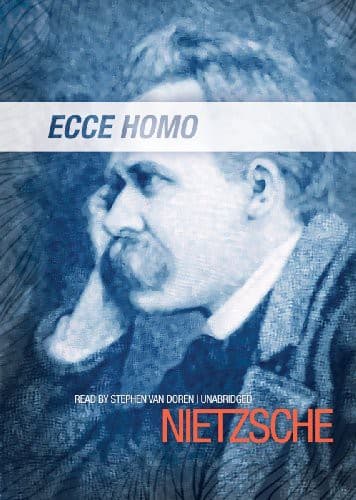
Ecce Homo: Complete Works, Volume SeventeenNietzsche, Friedrich Wilhelm
PhilosophyPhilosophy
Ecce Homo: Complete Works, Volume Seventeen
Nietzsche, Friedrich Wilhelm
Nietzsche, Friedrich Wilhelm, 1844-1900; Philosophers -- Germany -- Biography
I should not like to say that the last two essays in the _Thoughts
out of Season,_ associated with the names of Schopenhauer and Wagner
respectively, serve any special purpose in throwing light upon these
two cases, or in formulating their psychological problems. This of
course does not apply to a few details. Thus, for instance, in the
second of the two essays, with a profound certainty of instinct I
already characterised the elementary factor in Wagner's nature as a
theatrical talent which in all his means and inspirations only draws
its final conclusions. At bottom, my desire in this essay was to do
something very different from writing psychology: an unprecedented
educational problem, a new understanding of self-discipline and
self-defence carried to the point of hardness, a road to greatness
and to world-historic duties, yearned to find expression. Roughly
speaking, I seized two famous and, theretofore, completely undefined
types by the forelock, after the manner in which one seizes
opportunities, simply in order to speak my mind on certain questions,
in order to have a few more formulas, signs, and means of expression
at my disposal. Indeed I actually suggest this, with most unearthly
sagacity, on page 183 of _Schopenhauer as Educator._ Plato made use
of Socrates in the same way--that is to say, as a cipher for Plato.
Now that, from some distance, I can look back upon the conditions of
which these essays are the testimony, I would be loth to deny that they
refer simply to me. The essay _Wagner in Bayreuth_ is a vision of my
own future; on the other hand, my most secret history, my development,
is written down in _Schopenhauer as Educator._ But, above all, the
_vow_ I made I What I am to-day, the place I now hold--at a height from
which I speak no longer with words but with thunderbolts!--oh, how
far I was from all this in those days! But I saw the land--I did not
deceive myself for one moment as to the way, the sea, the danger--_and_
success! The great calm in promising, this happy prospect of a future
which must not remain only a promise!--In this book every word has
been lived, profoundly and intimately; the most painful things are not
lacking in it; it contains words which are positively running with
blood. But a wind of great freedom blows over the whole; even its
wounds do not constitute an objection. As to what I understand by being
a philosopher,--that is to say, a terrible explosive in the presence
of which everything is in danger; as to how I sever my idea of the
philosopher by miles from that other idea of him which includes even a
Kant, not to speak of the academic "ruminators" and other professors of
philosophy,--concerning all these things this essay provides invaluable
information, even granting that at bottom, it is not "Schopenhauer as
Educator" but "Nietzsche as Educator," who speaks his sentiments in
it. Considering that, in those days, my trade was that of a scholar,
Public-domain text, read in full here on John Shaqi.
Reviews
Reviews
No reviews yet
Be the first to share your thoughts on this work.
Join the Discussion
Join the discussion
Sign in to leave a comment or review.
Sign InorCreate an account