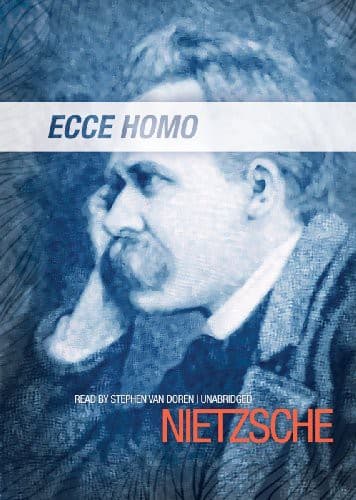
Ecce Homo: Complete Works, Volume SeventeenNietzsche, Friedrich Wilhelm
PhilosophyPhilosophy
Ecce Homo: Complete Works, Volume Seventeen
Nietzsche, Friedrich Wilhelm
Nietzsche, Friedrich Wilhelm, 1844-1900; Philosophers -- Germany -- Biography
and perhaps, also, that I understood my trade, the piece of austere
scholar psychology which suddenly makes its appearance in this essay is
not without importance: it expresses the feeling of distance, and my
profound certainty regarding what was my real life-task, and what were
merely means, intervals, and accessory work to me. My wisdom consists
in my having been many things, and in many places, in order to become
one thing--in order to be able to attain to one thing. It was part of
my fate to be a scholar for a while.
[Footnote 1: The Purists constitute a definite body in Germany, which
is called the _Deutscher Sprach-Verein._ Their object is to banish
every foreign word from the language, and they carry this process of
ostracism even into the domain of the menu, where their efforts at
rendering the meaning of French dishes are extremely comical. Strange
to say, their principal organ, and their other publications, are by
no means free either from solecisms or faults of style, and it is
doubtless to this curious anomaly that Nietzsche here refers.--TR.]
"HUMAN, ALL-TOO-HUMAN"
1
_Human all-too-Human,_ with its two sequels, is the memorial of a
crisis. It is called a book for free spirits: almost every sentence in
it is the expression of a triumph--by means of it I purged myself of
everything in me which was foreign to my nature. Idealism is foreign
to me: the title of the book means: "Where ye see ideal things I
see--human, alas! all-too-human things!" ... I know men better. The
word "free spirit" in this book must not be understood as anything
else than a spirit that has become free, that has once more taken
possession of itself. My tone, the pitch of my voice, has completely
changed; the book will be thought clever, cool, and at times both
hard and scornful. A certain spirituality, of noble taste, seems to
be ever struggling to dominate a passionate torrent at its feet. In
this respect there is some sense in the fact that it was the hundredth
anniversary of Voltaire's death that served, so to speak, as an excuse
for the publication of the book as early as 1878. For Voltaire, as the
opposite of every one who wrote after him, was above all a grandee of
the intellect; precisely what I am also. The name of Voltaire on one
of my writings--that was verily a step forward--in my direction....
Looking into this book a little more closely, you perceive a pitiless
spirit who knows all the secret hiding-places in which ideals are wont
to skulk--where they find their dungeons, and, as it were, their last
refuge. With a torch in my hand, the light of which is not by any
means a flickering one, I illuminate this nether world with beams that
cut like blades. It is war, but war without powder and smoke, without
warlike attitudes, without pathos and contorted limbs--all these things
would still be "idealism." One error after the other is quietly laid
upon ice; the ideal is not refuted,--it freezes. Here, for instance,
Public-domain text, read in full here on John Shaqi.
Reviews
Reviews
No reviews yet
Be the first to share your thoughts on this work.
Join the Discussion
Join the discussion
Sign in to leave a comment or review.
Sign InorCreate an account