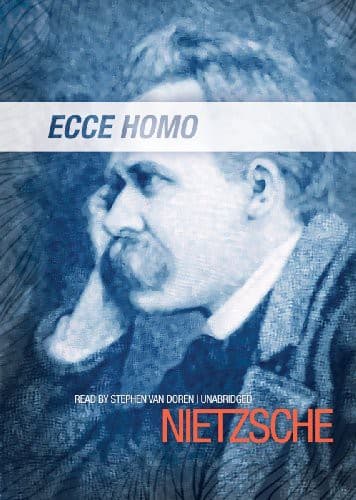
Ecce Homo: Complete Works, Volume SeventeenNietzsche, Friedrich Wilhelm
PhilosophyPhilosophy
Ecce Homo: Complete Works, Volume Seventeen
Nietzsche, Friedrich Wilhelm
Nietzsche, Friedrich Wilhelm, 1844-1900; Philosophers -- Germany -- Biography
I now wish to relate the history of _Zarathustra._ The fundamental
idea of the work, the _Eternal Recurrence,_ the highest formula of
a Yea-saying to life that can ever be attained, was first conceived
in the month of August 1881. I made a note of the idea on a sheet of
paper, with the postscript: "Six thousand feet beyond man and time."
That day I happened to be wandering through the woods alongside of the
Lake of Silvaplana, and I halted not far from Surlei, beside a huge
rock that towered aloft like a pyramid. It was then that the thought
struck me. Looking back now, I find that exactly two months before
this inspiration I had an omen of its coming in the form of a sudden
and decisive change in my tastes--more particularly in music. The
whole of _Zarathustra_ might perhaps be classified under the rubric
music. At all events, the essential condition of its production was
a second birth within me of the art of hearing. In Recoaro, a small
mountain resort near Vicenza, where I spent the spring of 1881, I and
my friend and maestro, Peter Gast--who was also one who had been born
again, discovered that the phœnix music hovered over us, in lighter
and brighter plumage than it had ever worn before. If, therefore, I
now calculate from that day forward the sudden production of the book,
under the most unlikely circumstances, in February 1883,--the last
part, out of which I quoted a few lines in my preface, was written
precisely in the hallowed hour when Richard Wagner gave up the ghost
in Venice,--I come to the conclusion that the period of gestation
covered eighteen months. This period of exactly eighteen months,
might suggest, at least to Buddhists, that I am in reality a female
elephant The interval was devoted to the _Gaya Scienza,_ which contains
hundreds of indications of the proximity of something unparalleled;
for, after all, it shows the beginning of _Zarathustra,_ since it
presents _Zarathustra's_ fundamental thought in the last aphorism
but one of the fourth book. To this interval also belongs that _Hymn
to Life_ (for a mixed choir and orchestra), the score of which was
published in Leipzig two years ago by E. W. Fritsch, and which gave
perhaps no slight indication of my spiritual state during this year,
in which the essentially yea-saying pathos, which I call the tragic
pathos, completely filled me heart and limb. One day people will sing
it to my memory. The text, let it be well understood, as there is
some misunderstanding abroad on this point, is not by me; it was the
astounding inspiration of a young Russian lady, Miss Lou von Salome,
with whom I was then on friendly terms. He who is in any way able
to make some sense of the last words of the poem, will divine why I
preferred and admired it: there is greatness in them. Pain is not
regarded as an objection to existence: "And if thou hast no bliss now
left to crown me--Lead on! Thou hast thy Sorrow still."
Public-domain text, read in full here on John Shaqi.
Reviews
Reviews
No reviews yet
Be the first to share your thoughts on this work.
Join the Discussion
Join the discussion
Sign in to leave a comment or review.
Sign InorCreate an account