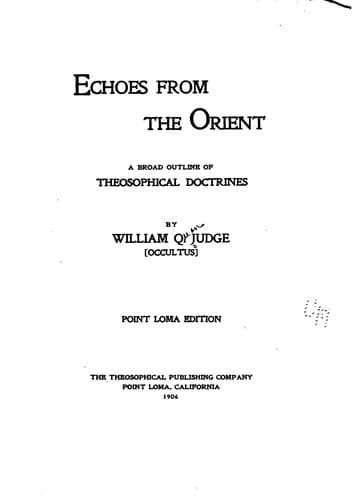
Echoes From The Orient: A Broad Outline of Theosophical Doctrines — John Shaqi
Echoes From The Orient: A Broad Outline of Theosophical DoctrinesJudge, William Quan
Religion
Echoes From The Orient: A Broad Outline of Theosophical Doctrines
Judge, William Quan
Theosophy
There is in one of the Hindû books a strange sentence respecting this
part of the subject, reading: "Perfection of body or superhuman powers
are produced by birth or by herbs or by incantations, penances, or
meditations."
Among mental afflictions esteemed as worse than any bodily hurt or loss
is that Karma from a preceding life which results in obscurity of such a
character that there is a loss of all power to conceive of the reality
of Spirit or the existence of soul--that is, materialism.
The last field of operation for this law may be said to be the psychical
nature. Of this in America we have numerous examples in mediums,
clairvoyants, clairaudients, mind-readers, hysteriacs, and all sorts of
abnormal sensitives. There could be no clairvoyant according to the
Oriental scheme if the person so afflicted, using as I think the proper
term, had not devoted much of previous lives to a one-sided development
of the psychical nature resulting now in powers which make the possessor
an abnormality in society.
A very strange belief of the Hindûs is that one which allows the
possibility of a change of state by a mortal of such a character that
the once man becomes a _Deva_ or lesser god. They divide nature into
several departments, in each of which are conscious powers or entities
called _Devas_, to put it roughly. Yet this is not so far apart from the
ideas of some of our best scientific men who have said there is no
reason why in each ray of the spectrum there may not be beings to us
unseen. Many centuries ago the Hindû thinker admitted this, and pushing
further on declared that a man might through a certain sort of Karma
become one of these beings, with corresponding enjoyment and freedom
from care, but with the certainty, however, of eventually changing back
again to begin the weary round of birth over again.
What might be called the doctrine of the nullification of Karma is an
application in this department of the well-known law in physics which
causes an equilibrium when two equal forces oppose each other. A man may
have in his Karmic account a very unpleasant cause and at the same time
a cause of opposite character. If these come together for expression at
the same time they may so counteract each other as that neither will be
apparent and the equilibrium is the equivalent of both. In this way it
is easy to understand the Biblical verse: "Charity covereth a multitude
of sins," as referring to the palliative effect of charitable deeds as
opposed to deeds of wickedness, and giving a reason for the mediæval
knight devoting some of the years of his life to almsgiving.
Public-domain text, read in full here on John Shaqi.
Reviews
Reviews
No reviews yet
Be the first to share your thoughts on this work.
Join the Discussion
Join the discussion
Sign in to leave a comment or review.
Sign InorCreate an account