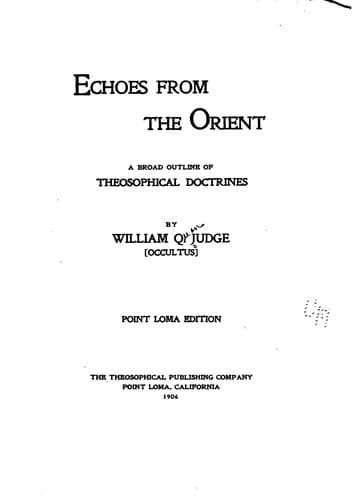
Echoes From The Orient: A Broad Outline of Theosophical Doctrines — John Shaqi
Echoes From The Orient: A Broad Outline of Theosophical DoctrinesJudge, William Quan
Religion
Echoes From The Orient: A Broad Outline of Theosophical Doctrines
Judge, William Quan
Theosophy
In the _Bhagavad-Gîtâ_, a book revered by all in India, the highest
place is given to what is called _Karma-Yôga_ or the Religion of the
Performance of Works and Duty, and there it is said: "He who, unattached
to the fruits of his actions, performs such actions as must be done, is
both renouncer and devotee; not he who kindles no sacrificial fires and
performs no ceremonies. He who remains inert, restraining the organs of
action, and pondering with his heart on objects of sense, is called a
false pietist of bewildered soul. But he who, restraining his senses by
his heart and being free from interest in acting, undertakes active
devotion through the organs of action, is praiseworthy."
XVIII.
That the doctrine of Karma is unjust, unsympathetic, and fatalistic has
been claimed by those who oppose it, but such conclusions are not borne
out by experience among those races who believe in it, nor will the
objections stand a close examination. The Hindûs and Buddhists
thoroughly believe in Karma, convinced that no one but themselves
punishes or rewards in this or any life, yet we do not find them cold or
unsympathetic. Indeed, in the relations of life it is well known that
the Hindû is as loving and tender as his American brother, and there are
as many instances of heroic self-sacrifice in their history as in ours.
Some go further than this and say that the belief in Karma and
Reïncarnation has made the Hindû more gentle in his treatment of men and
animals than are the Europeans, and more spiritual in his daily life.
Going deeper into their history, the belief in Karma is found side by
side with material works of great magnitude, and whose remains to this
day challenge our wonder, admiration, and respect; it is doubtful
whether we could ever show such triumphs over nature as can be seen at
any time in the rock-cut temples of Hindustan. So it would appear that
this doctrine of ours is not likely to produce bad or enervating effects
upon the people who accept it.
"But," says an objector, "it is fatalism. If Karma is Karma, if I am to
be punished in such and such a manner, then it will come about so
whether I will or not, and hence I must, like the Turk, say 'Kismet,'
and do nothing." Now, although the Mohammedan doctrine of Kismet has
been abused as fatalism, pure and simple, it was not so held by the
Prophet nor by his greatest disciples, for they taught that it was law
and not fate. And neither is Karma amenable to this objection. In the
minds of those who, having vaguely apprehended Karma as applying to one
life only, do not give the doctrine its true majestic, endless sweep,
fatalism is the verdict. When, on the other hand, each man is seen as
the fashioner of the fate for his next fleeting earth personality, there
can be no fatality in it, because in his own hand is the decree. He set
in motion the causes which will inevitably have certain results. Just as
easily he could have made different causes and thus brought about
different results.
Public-domain text, read in full here on John Shaqi.
Reviews
Reviews
No reviews yet
Be the first to share your thoughts on this work.
Join the Discussion
Join the discussion
Sign in to leave a comment or review.
Sign InorCreate an account