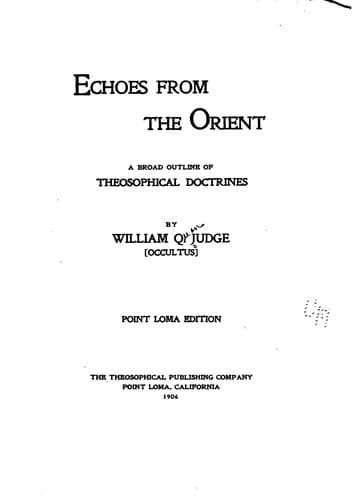
Echoes From The Orient: A Broad Outline of Theosophical Doctrines — John Shaqi
Echoes From The Orient: A Broad Outline of Theosophical DoctrinesJudge, William Quan
Religion
Echoes From The Orient: A Broad Outline of Theosophical Doctrines
Judge, William Quan
Theosophy
In the Egyptian _Book of the Dead_, chapter x describes the place where,
after death, disembodied souls remain in different degrees of
perfection. Some are shown as taking wheat three cubits high, while
others are only permitted to glean it--"he gleaned the fields of
Aanroo." Thus some enjoy the perfection of spiritual bliss, while others
attain only to minor degrees in that place or state where divine justice
is meted out to the soul.
Devachan is the land of reward; the domain of spiritual effects. The
word spiritual here refers to disembodiment; it must only be used as
relative to our material existence. The Christian demonstrates this fact
by the material _entourage_ of his heaven. In the _Secret Doctrine_, H.
P. Blavatsky says: "Death itself is unable to deliver man from it
[Karma], since death is simply the door through which he passes to
another life on earth, after a little rest on its threshold--Devachan."
Devachan, then, is the threshold of life. In the Hindû system it is
etymologically the place of the gods, Indra's heaven. Indra is the
regent of heaven, who gives to those who can reach his realm
long-enduring gifts of happiness and dominion. The _Bhavagad-Gîtâ_ says:
"After enjoying felicity for innumerable years in the regions of Indra,
he is born again upon this earth."
For the purpose of this article, we assume that the entire man, minus
the body, goes into Devachan. This, however, is not so. The
_post-mortem_ division of our sevenfold constitution given by Theosophy
is exact. It exhibits the basis of life, death and reïncarnation. It
shows the composite being, man, in analogy with that other composite
being, nature. Both are a unity in diversity. Man, suspended in nature,
like her, divides and reünites. This sevenfold division will be treated
in a future article.
Public-domain text, read in full here on John Shaqi.
Reviews
Reviews
No reviews yet
Be the first to share your thoughts on this work.
Join the Discussion
Join the discussion
Sign in to leave a comment or review.
Sign InorCreate an account