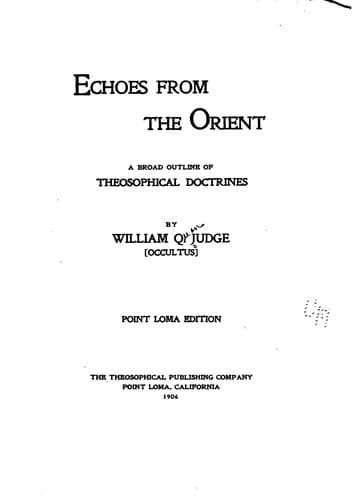
Echoes From The Orient: A Broad Outline of Theosophical DoctrinesJudge, William Quan
Religion
Echoes From The Orient: A Broad Outline of Theosophical Doctrines
Judge, William Quan
Theosophy
Devachan, being a state of prolonged subjective happiness after the
death of the body, is plainly the heaven of the Christian, but with a
difference. It is a heaven made scientifically possible. Heaven itself
must accord with the divine laws projected into nature. As sleep is a
release from the body, during which we have dreams, so death is a
complete separation and release, after which in Devachan we dream until,
on being again incarnated in a new body on earth, we come once more into
what we call waking existence. Even the human soul would weary of the
ceaseless round of rebirths, if some place or state were not provided in
which rest could be obtained; in which germinating aspirations,
restricted by earth-life, could have their full development. No energy
can be annihilated, least of all a psychic energy; these must somewhere
find an outlet. It is found in Devachan; this realization is the rest of
the soul. Its deepest desires, its highest needs are there enjoyed.
There every hope blooms out in full and glorious flower. To prolong this
blissful state, Hindû books give many incantations and provide
innumerable ceremonies and sacrifices, all of them having for end and
aim a long stay in Devachan. The Christian does precisely the same. He
longs for heaven, prays that he may go there, and offers up to his God
such propitiatory rites and acts as seem best to him, the only
difference being that he does not do it half so scientifically as the
Hindû. The Hindû is also more vivid in his conception of this heaven
than the Christian is. He postulates many places or conditions adapted
to the energic and qualitative differences between souls. Kama-loka and
other states are where concrete desires, restricted by life in the body,
have full expression, while in Tribûvana the abstract and benevolent
thinkers absorb the joys of lofty thought. The orthodox heaven has no
such proviso. It also ignores the fact that a settled monotony of
celestial existence would exhaust the soul--would be stagnation, not
growth. Devachanic life is development of aspiration, passing through
the various stages of gestation, birth, cumulative growth, downward
momentum and departure to another condition, all rooted in joy. There is
nothing in the mere fact of death to mould a soul anew. It is a group of
psychic energies, and heaven must have something in common with these,
or why should it gravitate there? Souls differ as men do. In Devachan
each one receives that degree of bliss which it can assimilate; its own
development determines its reward. The Christian places all the snuffy
old saints as high as other holy souls, sinking genius to the level of
the mediocre mass, while the Hindû gives infinite variety of occupation
and existence suited to grave and gay, the soul of genius or of poetry.
No one sits in undesired seats, nor sings psalms he never liked, nor
lives in a city which might pall upon him if he were forever compelled
to walk its pearly streets.
Public-domain text, read in full here on John Shaqi.
Reviews
Reviews
No reviews yet
Be the first to share your thoughts on this work.
Join the Discussion
Join the discussion
Sign in to leave a comment or review.
Sign InorCreate an account