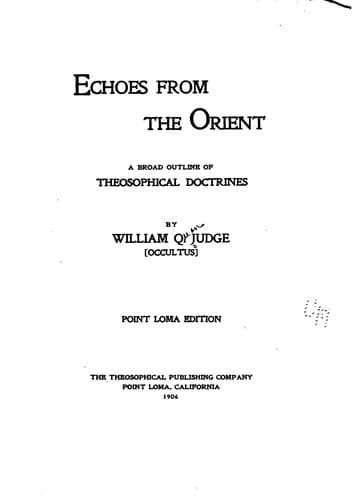
Echoes From The Orient: A Broad Outline of Theosophical DoctrinesJudge, William Quan
Religion
Echoes From The Orient: A Broad Outline of Theosophical Doctrines
Judge, William Quan
Theosophy
The laws of cause and effect forbid that
Devachan should be monotonous. Results are proportionate to antecedent
energies. The soul oscillates between Devachan and earth-life, finding
in each conditions suited to its continuous development, until, through
effort, it reaches a perfection in which it ceases to be the subject of
the laws of action and reäction, becoming instead their conscious
co-worker.
Devachan is a dream, but only in the sense in which objective life can
be called such. Both last until Karma is satisfied in one direction, and
begins to work in the other. The Devachanee has no idea of space or
time except such as he makes for himself. He creates his own world. He
is with all he ever loved, not in bodily companionship, but in one to
him real, close and blissful. When a man dies, the brain dies last. Life
is still busy there after death has been announced. The soul marshals up
all past events, grasps the sum total, the average tendency stands out,
the ruling hope is seen. Their final aroma forms the keynote of
Devachanic existence. The lukewarm man goes neither to heaven nor hell.
Nature spews him out of her mouth. Positive conditions, objective or
subjective, are only reached through positive impulsion. Devachanic
distribution is governed by the ruling motive of the soul. The hater
may, by reäction, become the lover, but the indifferent have no
propulsion, no growth.
XX.
It is quite evident to the unprejudiced inquirer that Christian priests
for some reason or other studiously ignore the composite nature of man,
although their great authority, St. Paul, clearly refers to it. He spoke
of body, soul, and spirit, they only preach of body and soul; he
declared we had a spiritual body, they remain misty as to the soul's
body and cling to an absurd resurrection of the material casket. It
became the duty of Theosophists to draw the attention of the modern mind
once more to the Oriental division of man's constitution, for through
that alone can an understanding of his state before and after death be
attained. The division laid down by St. Paul is threefold, the Hindû one
is of a sevenfold character. St. Paul's is meant for those who require
broad outlines, but do not care to inquire into details. Spirit, soul,
and body, however, include the whole seven divisions, the latter being a
more complete analysis; and it is suspected by many deep thinkers that
Paul knew the complete system but kept it back for good reasons of his
own.
An analysis of body discloses more than mere molecular structure, for it
shows a force or life or power that keeps it together and active
throughout its natural period. Some writers on Theosophical subjects,
dealing more or less accurately with the Eastern system, have called
this _Prâna_ or _Jîva_; others, however, call it _Prâna_ alone, which
seems more appropriate, because the human aspect of the life force is
dependent upon _Prâna_, or _breath_.
Public-domain text, read in full here on John Shaqi.
Reviews
Reviews
No reviews yet
Be the first to share your thoughts on this work.
Join the Discussion
Join the discussion
Sign in to leave a comment or review.
Sign InorCreate an account