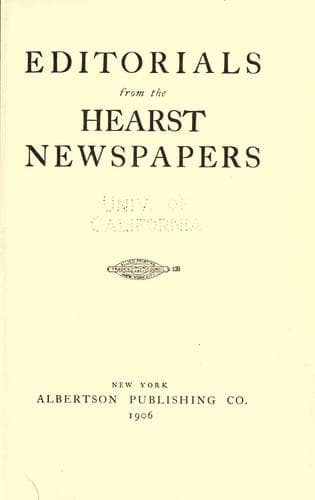
Editorials from the Hearst NewspapersBrisbane, Arthur
Philosophy
Editorials from the Hearst Newspapers
Brisbane, Arthur
Editorials; Essays
"Then the Lord answered Job out of the whirlwind and said . . . .
Where wast thou when I laid the foundations of the earth?
Declare, if thou hast understanding."--Job xxxviii. 1, 4.
Since men have lived on earth their feeble intellects have
struggled to realize the majesty of God.
Succeeding nations and civilizations have expressed through laws
or religions their puny conceptions of the power that controls
the universe.
As mental and moral standards have improved, there has been
constant improvement in the conception of God.
The Greeks and Romans imagined a variety of gods, and attributed
to these the vices and weaknesses of men.
The Fijians worshipped a god who devoured the souls of the dead,
inflicting torture in the eating, but mercifully releasing souls
from pain when the meal was ended.
The ancient Mexicans went to war "because their gods demanded
something to eat." Their armies fought "only endeavoring to take
prisoners, that they might have men to feed those gods." ----
Even with the birth of the one great idea--THE UNITY OF GOD--the
personality of the universal Creator was but a reflection of His
worshippers.
He was a "jealous" God, a "man of war." "God Himself is with us
for our captain."-- Chron. xiii., 12.
God dwelt in a city made of nothing cheaper than gold and
precious stones. For His own glory, He maintained a court
Oriental in form, with strange beasts to sing His praises, and He
tortured forever and ever creatures that He had made.
The present conception of an omnipotent God has changed greatly
since the old days, when cruelty was the rule and was admired.
There is to-day insistence on God's LOVE, on His JUSTICE, on His
MERCY that "endureth forever"--there is practically no teaching
of the old belief that a creature, born of circumstances, and
good or bad as circumstances may determine, is to suffer endless
torment under never-changing conditions of horror. ----
The writing of this editorial is based upon frequent reading of
the book of Job. In that ancient and wonderful book, as in no
other writing, the Jewish forces of poetry and of prophecy are
exhausted in the effort to portray God's majesty.
All of the old prophet's knowledge of the world, all of his
mystic notions of sidereal government, are used in the effort to
glorify his Creator.
"Hast thou commanded the morning since thy days?
"Canst thou send lightnings, that they may go and say unto
thee, Here we are?
"Canst thou bind the unicorn with his band in the furrow?
"Gavest thou the goodly wings unto the peacocks?
"Canst thou draw out leviathan with an hook?
"Will he make many supplications unto thee? Will he speak
soft words unto thee?
"Hast thou entered into the treasures of the snow? or hast
thou seen the treasures of the hail?"
Thus through chapters of greatest beauty the primitive mind seeks
to portray for the benefit of other primitive minds the
omnipotence of the world's Ruler. ----
Public-domain text, read in full here on John Shaqi.
Reviews
Reviews
No reviews yet
Be the first to share your thoughts on this work.
Join the Discussion
Join the discussion
Sign in to leave a comment or review.
Sign InorCreate an account