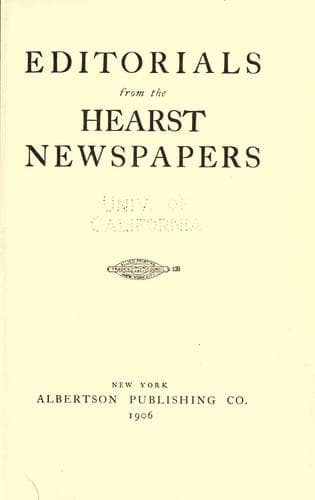
Editorials from the Hearst Newspapers — John Shaqi
Editorials from the Hearst NewspapersBrisbane, Arthur
Philosophy
Editorials from the Hearst Newspapers
Brisbane, Arthur
Editorials; Essays
What hope has man of conceiving, even approximately, the great
law-giving Force that rules the universe? Shall we ever do more
than attribute to Him those qualities which our own pygmy minds
admire? Shall we forever conceive Him as a glorified
"individual"?
We believe that in the Book of Job there is suggested the method
of studying God that alone can aid us to a better, higher
conception.
The study of God must be prosecuted through the study of
astronomy, and this the old prophet foreshadows clearly:
"Canst thou bind the sweet influences of Pleiades, or loose
the bands of Orion?
"Canst thou bring forth Mazzaroth in his season? or canst
thou guide Arcturus with his sons?"
Long years ago children were taught to admire a god who created a
leviathan, a unicorn, and "Behemoth."
Children of the future will be told:
You live on a globe twenty-five thousand miles round. It travels
ceaselessly through space at a speed of eighteen miles a second.
Compared to the huge sun that lights and gives us life, our earth
is but a pinhead, and the sun itself is but one tiny dot in the
ocean of space. Through that space the sun rushes on an errand
unknown, carrying us with it.
Everything moves, revolves, rushes ceaselessly, yet a balance
registering the one-thousandth part of a grain is not adjusted as
nicely as these huge behemoths of limitless space. Laplace shows
positive proof that the earth, travelling eighteen miles per
second, has not changed the period of its rotation by the
hundredth part of a second in two thousand years.
The mind of the future, imbued with respect for the Force that
controls, conducts and makes the laws for the universe, will
attain more nearly to a conception of God. But a study of God
will remain man's chief and constant effort while he lives here.
That study is never-ending.
THE FASCINATING PROBLEM OF IMMORTALITY
(If you read this you will probably feel that you have wasted
time.)
If you travel back far enough you can see in your mind's eye a
primitive man with long, red hair, shivering in some icy pool.
He has taken refuge there from a pursuing bear or other foe. He
sees that he must die of cold or of the bear's teeth. His dark
mind--product of a brain primitive and poor in
convolutions--contemplates vaguely the prospect ahead of him. He
hopes that after death he may through some mysterious kindness be
permitted to meet again the red-haired women and the wolfish cave
children left behind.
There, in the cave man's mind, is the first craving for
immortality. Born in that poor brain long centuries ago, it has
steadily grown stronger with man's mental development. ----
No man looks at death without looking beyond it. None but has a
craving for a future life, with consciousness of his personality
AND WITH RECOLLECTION OF FRIENDS, FACES AND DEEDS HERE.
Say to a man, "You shall be immortal, but you shall not know that
you are you." He will not give you thanks for such immortality.
Public-domain text, read in full here on John Shaqi.
Reviews
Reviews
No reviews yet
Be the first to share your thoughts on this work.
Join the Discussion
Join the discussion
Sign in to leave a comment or review.
Sign InorCreate an account