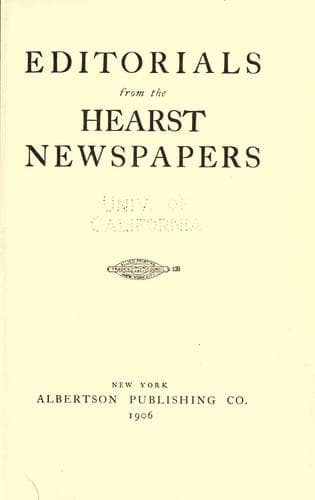
Editorials from the Hearst NewspapersBrisbane, Arthur
Philosophy
Editorials from the Hearst Newspapers
Brisbane, Arthur
Editorials; Essays
So strong is man's craving for personal, individual immortality
that hell with its fires would be preferred by many to
annihilation. The strongest argument against immortality--weak
and ignorant at best--is but a frantic attempt of the mind to
prove negatively the existence of what it covets.
Fortunately for human happiness in general, FAITH, covers the
requirements of millions. They live and die contented, the
instinct within them fortified by the teachings of a faith not to
be questioned. ----
But what of the men and women who ask for evidence, or at least
for plausible argument, proving the reasonableness of
immortality? What can be said to please them?
Not much, alas! Probably because we are still so undeveloped
that it would be, for many reasons, unsafe to let us know how
great a future is before us. Strongest in hope is the
argument of Charles Fourier, based on what he declared to be
a natural law.
"Attractions are proportionate to destinies."
By this Fourier meant that a universal longing among human
beings was certain proof that their ultimate destiny involved
the fulfilment of the longing. The little girl fondling a doll
foretells maternity. The hectoring boy foretells the soldier's
career. No universal attraction, save with a destiny
proportionate. ----
The human race since it began to think and believe has thought of
and believed in immortality. The half wise declare that belief
in immortality and a spirit world came to savage peoples through
dreams, that it has been kept alive through superstition and the
power of religion. Trivial, certainly, is such an explanation of
a phenomenon as wide as mankind's existence. ----
A very consoling fact for the doubter is this. The strongest
minds born on the earth have almost invariably, at some stage
of development, rejected belief in immortality--only to return
to the belief, or at least to the HOPE, with fuller age and riper
wisdom. That no great mind has seen any positive argument
against the hope of immortality is certainly comforting to all
of us. Intelligence can always refute improbability and
falsehood.
----
What about the nature of immortality? The Indian hopes for dogs
and hunting, the Turk for a life of which the least said the
better. The Christian, borrowing his ideas from the writings of
the old Hebrews, looks forward to what may be called a solid gold
existence--everything made of gold or of something more
expensive.
We do not think that religious docility demands implicit belief
in any of the published details of our future existence. Gold is
not comfortable; jasper would not well replace the green turf.
Is it not more reasonable to assume, since immortality is to be
ours, that it is ours now and always has been? We cannot imagine
creation of the indestructible. Is it not sensible to take
literally that most beautiful invocation: "Thy kingdom come ON
EARTH as it is in heaven"?
Public-domain text, read in full here on John Shaqi.
Reviews
Reviews
No reviews yet
Be the first to share your thoughts on this work.
Join the Discussion
Join the discussion
Sign in to leave a comment or review.
Sign InorCreate an account