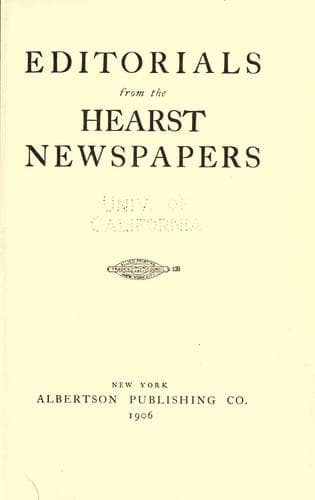
Editorials from the Hearst NewspapersBrisbane, Arthur
Philosophy
Editorials from the Hearst Newspapers
Brisbane, Arthur
Editorials; Essays
God does not exist, because I cannot prove His existence: I can
prove everything else. With my law of gravitation I point to a
speck in space and say: "You'll find a new planet there," and
you find it. If a God existed could I not also point to Him? If
I can trace a comet in its flight, could I not trace the comet's
maker?
Huxley says: "The cosmic process has no sort of relation to
moral ends." That's a philosopher's way of saying something
foolish. Lalande, the astronomer, remarked that he had swept the
entire heavens with his telescope and found no God there. That's
funnier than any ant who should say: "I've searched this whole
dead caterpillar and found no God, so THERE IS NO GOD." The
corner of space which our telescopes can "sweep" is smaller,
compared to the universe, than a dead caterpillar compared with
this earth.
Moleschott, an able physiologist, believed that phosphorus was
essential to mental activity. Perhaps he did prove that. But he
said: "No thought without phosphorus," and thought he had wiped
the human soul out of existence. Philosophers do not laugh at
Moleschott. But they would laugh at a savage who would say:
"I have discovered that there is a catgut in a fiddle. No fiddle
without catgut--no music without cats. Don't talk to me about
soul or musical genius--it's all catgut."
We peek out at this universe from our half-developed corner of
it. We see faintly the millions of huge suns circling with their
planet families billions of miles away. We see our own little
sun rise and set; we ask ourselves a thousand foolish questions
of cause and Ruler--and because we cannot answer, we decry faith.
Wise doubter, look at a small piece of iron. It looks solid.
You suppose that its various parts touch. But submit it to cold.
You make it smaller. Then the particles did not touch. Do they
touch now? No; relatively they are farther apart than this
planet from its nearest neighbor.
That piece of iron, apparently solid, consists of clusters of
atoms wonderfully grouped, each cluster called a molecule. The
molecular cluster is invisible, millions of clusters in the
smallest visible fragment. The atom is accepted by science as
the final particle of matter. Its name indicates that it is
supposed to be indivisible. When science gets to the atom it
calmly gives up and says: "That is so small that it can no
longer be divided." A reasonable enough conclusion on the
surface, considering that you might have millions of atoms of
iron in one corner of your eye and not know it.
But why should the atom be incapable of further division? If it
is any size at all it can be thought of as split.
Where does the divisibility of matter end, if anywhere? What is
there SOLID about iron? Nothing in reality, except that it seems
to us solid. Already, with the X-ray, we can look through it.
Forces such as heat and electricity pass through it more readily
than through free air.
Public-domain text, read in full here on John Shaqi.
Reviews
Reviews
No reviews yet
Be the first to share your thoughts on this work.
Join the Discussion
Join the discussion
Sign in to leave a comment or review.
Sign InorCreate an account