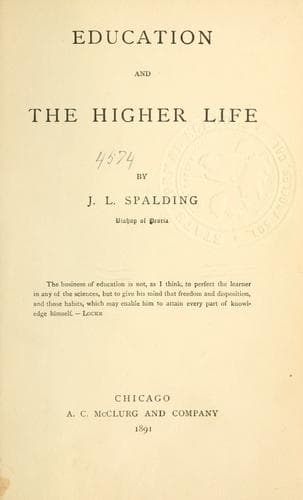
Education and the Higher LifeSpalding, John Lancaster
Religion
Education and the Higher Life
Spalding, John Lancaster
Education
himself ready to give Protagoras, not only whatever he himself
possesses, but also the property of his friends, if he will but teach
him wisdom. Superior knowledge was to them of all things the most
admirable and the most to be desired. What noble thoughts have they not
concerning education? "An intelligent man," says Plato, "will prize
those studies which result in his soul getting soberness, righteousness,
and wisdom, and will less value the others." The culture of the mind is
made a kind of religion, in the spreading of which the personal
influence of the teacher is not less active than the truths he sets
forth. Bonds of affection bind the disciple to the master whose words
have for him the sacredness of wisdom and the charm of genius, power to
confirm the will, and warmth and color whereby the imagination is
raised.
This secret of making knowledge attractive, of clothing truth in chaste
and beautiful language, of associating it with whatever is fair and
noble in Nature, and of relating it to life and conduct, which is part
of the genius of Greece, still lives in her literature; and to read the
words of her poets, orators, and philosophers is to feel the presence of
a high and active spirit, is to breathe in an intellectual atmosphere of
light and liberty, is of itself enlargement and cultivation of mind.
Hence, in the realms of thought, the Greeks are the civilizers and
emancipators of the world; and whoever thinks, is to some extent their
debtor. The music of their eloquence and poetry can never grow silent;
the forms of beauty their genius has created can never perish, and never
cease to win the admiration and love of noble minds and gentle hearts,
or to be the inspiration, generation after generation, to high thoughts
and heroic moods. So long as glory, beauty, freedom, light, and gladness
shall seem good and fair, so long will the finer spirits of the world
feel the attraction and the charm of Greece, and know the sweet surprise
which thrilled the heart of Keats when first he read Homer:--
"Then felt I like some watcher of the skies
When a new planet swims into his ken,
Or like stout Cortez when with eagle eyes
He stared at the Pacific, and all his men
Looked at each other with a wild surmise,
Silent, upon a peak in Darien."
In a less degree, Roman literature, which is the offspring of Greek
culture, has value as an intellectual stimulus and discipline. Here also
the youthful mind is brought into the presence of a great and noble
people, who, if they have less genius and a duller sense of beauty than
the Greeks, excel them in steadiness of purpose, in dignity of
character, in reverence for law and religion, and above all in the art
of governing.
Public-domain text, read in full here on John Shaqi.
Reviews
Reviews
No reviews yet
Be the first to share your thoughts on this work.
Join the Discussion
Join the discussion
Sign in to leave a comment or review.
Sign InorCreate an account