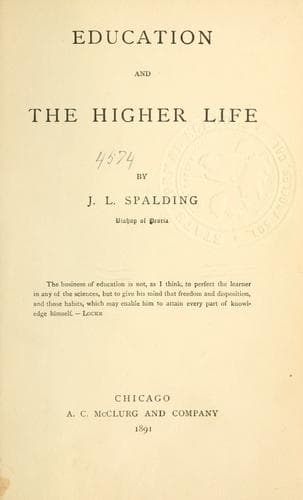
Education and the Higher LifeSpalding, John Lancaster
Religion
Education and the Higher Life
Spalding, John Lancaster
Education
The educational value of the classics does not lie so much in the Greek
and Latin languages as in the type of mind, the sense of proportion and
beauty, the heroic temper, the philosophic mood, the keen relish for
high enterprise, and the joyful love of life which they make known to
us. The world to which they introduce us is so remote that the
pre-occupations and vulgarities of the present, by which we all are
hemmed and warped, fall away from us; and it is at the same time so real
and of such absorbing interest that we are caught up in spirit and
carried to the Attic Plain and the hills of Latium. They are useful, not
because they teach us anything that may not be learned and learned more
accurately from modern books, but because they move the mind, fire the
heart, ennoble and refine the imagination in a way which nothing else
has power to do. They are sources of inspiration; they first roused the
modern mind to activity; and the potency of their influence can never
cease to be felt by those whose aptitudes lead them to the love of
intellectual perfection, who delight in the free play of the mind, who
are attracted by what is symmetrical, who have the instinct for beauty,
who swim in a current of ideas as naturally as birds fly in the air.
They appeal to the mind as a whole, stimulate all its faculties, awaken
a many-sided sympathy both with Nature and with the world of men. They
widen our view of life, bring forth in us the consciousness of our
kinship with the human race, and of the application to ourselves,
however common and uninspiring our surroundings may be, of the best
thoughts and noblest deeds which have ever sprung from the brain and
heart of man. They help to make one, again to quote Plato, "A lover, not
of a part of wisdom, but of the whole; who has a taste for every sort of
knowledge, and is curious to learn and is never satisfied; who has
magnificence of mind, and is a spectator of all time and all existence;
who is harmoniously constituted, of a well-proportioned and gracious
mind, whose own nature will move spontaneously toward the true being of
everything; who has a good memory, and is quick to learn, noble,
gracious, the friend of truth, justice, courage, temperance." The ideal
presented is that of complete harmonious culture, the aim of which is
not to make an artisan, a physician, a merchant, a lawyer, but a man
alive in all his faculties, touching the world at many points, for whom
all knowledge is desirable, all beauty lovable, and for whom fine
bearing and noble acting are indispensable.
Public-domain text, read in full here on John Shaqi.
Reviews
Reviews
No reviews yet
Be the first to share your thoughts on this work.
Join the Discussion
Join the discussion
Sign in to leave a comment or review.
Sign InorCreate an account