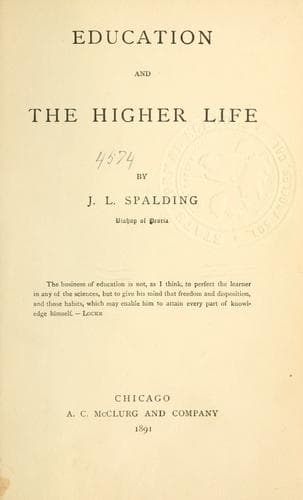
Education and the Higher LifeSpalding, John Lancaster
Religion
Education and the Higher Life
Spalding, John Lancaster
Education
There is doubtless a disciplinary value in the study of physical
science. It trains the mind to habits of patient attention, of careful
observation, teaches the danger of hasty generalization, and diminishes
intellectual conceit; but these results may also be obtained by other
means. The aim of education is not simply to develop this or the other
faculty, however indispensable, nor yet to make one thoroughly
conversant with a particular order of facts, but the aim is to bring
about a conscious participation in the life of the race, to evoke all
the powers of man, so that his whole being shall be quickened and made
responsive to the touch of things seen and unseen; and the study of
science is less adapted to the attainment of this end than the study of
human letters. The scientific temper draws to specialties; and
specialists are narrow, are incomplete. They, each in his own line, do
good work, and are the chief agents for the increase of natural
knowledge, and are, we may grant, leaders in every kind of improvement;
but like the operatives who provide our comforts and luxuries, they are
themselves warped and crippled by what they do. The habit of looking at
a single order of facts, coldly and always from the same point of view,
takes from the mind flexibility, weakens the imagination, and puts
fetters on the soul; and hence though it is important that there be
specialists, the kind of education by which they are formed, while it is
suited to make a geologist, a chemist, a mathematician, or a botanist,
is not suited to call forth the free and harmonious play of all man's
powers. We do not live on facts alone, much less on facts of a single
kind. Religion and poetry, love, hope, and imagination are as essential
to our well-being as science. Human life is knowledge, is faith, is
conduct, is beauty, is manners; it unfolds itself in many directions and
shoots its roots into infinitude; and for the general purposes of
education, science is learned to best advantage when it is embodied in
literature, and its methods and results, rather than the details of its
work, are presented to us. Whatever it is able to do, to improve the
mind, to widen the range of thought, to give true notions of the
workings of Nature,--it will do for whoever learns accurately its
general conceptions and results; and these cannot remain unknown to him
whose aim is culture, for such an one is, as Plato says, "A lover not of
a part of wisdom, but of the whole, and has a taste for every sort of
knowledge, and is curious to learn, and is never satisfied; and though
he will not know medicine like a physician, or the heavens like an
astronomer, or the vegetable kingdom like a botanist, his mind will play
over all these realms with freedom, and he will know how to relate the
principles and facts of all the sciences to our sense for beauty, for
conduct, for life and religion in a way which a mere specialist can
never find." And his view will not only be wider and less impeded, it
Public-domain text, read in full here on John Shaqi.
Reviews
Reviews
No reviews yet
Be the first to share your thoughts on this work.
Join the Discussion
Join the discussion
Sign in to leave a comment or review.
Sign InorCreate an account