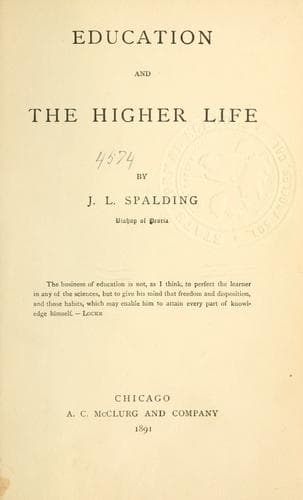
Education and the Higher LifeSpalding, John Lancaster
Religion
Education and the Higher Life
Spalding, John Lancaster
Education
It is needless to point out in what, or why, the Greeks failed, since
here there is question only of intellectual life, and in this they did
not fail. Nor is there any thought, in what has here been said, of
depreciating the worth of the study of science, without a certain
knowledge of which no one, in this age, can in any true sense, be called
educated. Whoever, indeed, learns a language properly, acquires
scientific knowledge; and the Greeks are not only the masters in poetry
and eloquence, they are also the guides to the right use of reason and
to scientific method, and the teachers of mathematics, logic, and
physics. He who pursues culture, in the Greek spirit, who desires to see
things as they are, to know the best that has been thought and done by
men, will fear nothing so much as the exclusion of any truth, and he
will be anxious to acquaint himself not only with the method, but as
far as possible with the facts, of physical science. Still he perceives
that however great the value of natural knowledge may be, it is, as an
instrument of culture, inferior to literature. We are educated by what
calls forth in us love and admiration, by what creates the exalted mood
and the steadfast purpose. In bowing with reverence to what is above us,
we are uplifted. When we are moved, we are more alive; we are stronger,
tenderer, nobler. Now to look upon Nature with the detective eye of the
man of science is to be cold and unsympathetic; to learn by methodic
experiment is to gain knowledge, which, since it is only remotely or
indirectly related to life, is but little interesting. Such knowledge is
a fragment, and a fragment extremely difficult to fit into the temple
built by thought and love, by hope and imagination; and hence when we
have learned a great deal about chemical elements, geologic epochs,
correlation of forces, and sidereal spaces, we are rather astonished
than enlightened. We are brought into the presence of a world which is
not that of the senses, nor yet that which faith, hope, and love
forebode; and the bearing it may have upon human life is of more
interest to us than the facts made known. We are, indeed, curious to
know whatever may, with any certainty, be told us of atoms and
biogenesis; but our real concern is to learn what significance such
truth may have in its relation to questions of God and the soul.
Public-domain text, read in full here on John Shaqi.
Reviews
Reviews
No reviews yet
Be the first to share your thoughts on this work.
Join the Discussion
Join the discussion
Sign in to leave a comment or review.
Sign InorCreate an account