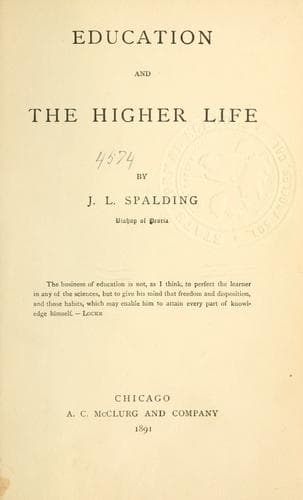
Education and the Higher LifeSpalding, John Lancaster
Religion
Education and the Higher Life
Spalding, John Lancaster
Education
to his thought; and to write as a disciple is to write in an inferior
way, since the mind at its best is illumined by truth itself and not
taught by the words of another. It is not to be believed that this
great, intelligent, yearning American world will content itself with the
trick and mannerism of foreign accent and style, or that those who build
on any other than the broad foundation of our own national life shall be
accepted as teachers and guides. There is, of course, no method known to
man by which a great author may be formed; no science which teaches how
a literature may be created. The men who have written what the world
will not permit to die have written generally without any clear
knowledge of the worth of their work, just as great discoverers and
inventors seem to stumble on what they seek; nevertheless one may hope
by right endeavor to make himself capable of uttering true thoughts so
that they shall become intelligible and attractive to others; he may
educate himself to know and love the best that has been spoken and
written by men of genius, and so become a power to lift the aims and
enlarge the views of his fellow-men. If many strive in this way to
unfold their gifts and to cultivate their faculties, their influence
will finally pervade the life and thought of thousands, and it may be of
the whole people.
I do not at all forget Aristotle's saying that "life is practice and not
theory;" that men are born to do and suffer, and not to dream and weave
systems; that conduct and not culture is the basis of character and the
source of strength; that a knowledge of Nature is of vastly more
importance to our material comfort and progress than philosophy, poetry,
and art. This is not to be called in question; but in this country and
age it seems hardly necessary that it be emphasized, for what is the
whole world insisting upon but the necessity of scientific instruction,
the importance of practical education, the cultivation of the
money-getting faculty and habit, and the futility of philosophy, poetry,
and art? Who is there that denies the worth of what is useful? Where is
there one who does not approve and encourage whatever brings increase of
wealth? Are we not all ready to applaud projects which give promise of
providing more abundant food, better clothing, and more healthful
surrounding for the poor? Does not our national genius seem to lie
altogether in the line of what is practically useful? Is it not our
boast and our great achievement that we have in a single century made
the wilderness of a vast continent habitable, have so ploughed and
drained and planted and built that it can now easily maintain hundreds
of millions in gluttonous plenty? Is not our whole social and political
organization of a kind which fits us to deal with questions and affairs
that concern our temporal and material welfare? What innumerable
individuals among us are congressmen, legislators, supervisors, bank and
Public-domain text, read in full here on John Shaqi.
Reviews
Reviews
No reviews yet
Be the first to share your thoughts on this work.
Join the Discussion
Join the discussion
Sign in to leave a comment or review.
Sign InorCreate an account