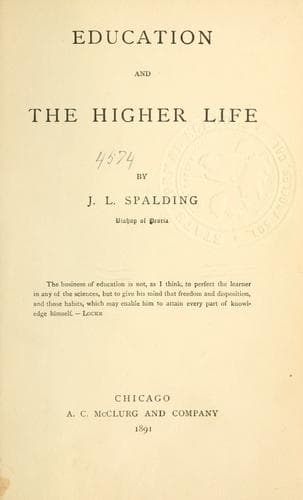
Education and the Higher LifeSpalding, John Lancaster
Religion
Education and the Higher Life
Spalding, John Lancaster
Education
school directors, presidents of boards and companies, committee-men,
councilmen, heads of lodges and societies, lawyers, professors,
teachers, editors, colonels, generals, judges, party-leaders, so that
the sovereign people seems to have life and being only in its titled
representatives! What does this universal reign of title and office mean
but the practical education which responsibility gives? If from the
midst of this paradise of utility, materialism, and business, a voice is
raised to plead for culture, for intelligence, for beauty, for
philosophy, poetry, and art, why need any one take alarm? While human
nature remains what it is, can there be danger that the many will be
drawn away from what appeals to the senses, to what the soul loves and
yearns for? If the Almighty God does not win the multitude to the love
of righteousness and wisdom, how shall the words of man prevail?
It is a mistake to oppose use to beauty, the serviceable to the
excellent, since they belong together. Beauty is the blossom that makes
the fruit-tree fair and fragrant. Life means more than meat and drink,
house and clothing. To live is also to admire, to love, to lose one's
self in the contemplation of the splendor with which Nature is clothed.
Human life is the marriage of souls with things of light. Its basis,
aim, and end is love, and love makes its object beautiful. Man may not
even consent to eat, except with decency and grace; he must have light
and flowers and the rippling music of kindly speech, that as far as
possible he may forget that his act is merely animal and useful. He will
lose sight of the fact that clothing is intended for protection and
comfort, rather than not dress to make himself beautiful. To speak
merely to be understood, and not to speak also with ease and elegance,
is not to be a gentleman. How easily words find the way to the heart
when uttered in melodious cadence by the lips of the fair and young.
Home is the centre and seat of whatever is most useful to us; and yet to
think of home is to think of spring-time and flowers, of the songs of
birds and flowing waters, of the voices of children, of floating clouds
and sunsets that linger as though heaven were loath to bid adieu to
earth. The warmth, the color, and the light of their boyish days still
glow in the hearts and imagination of noble men, and redeem the busy
trafficking world of their daily life from utter vulgarity. What hues
has not God painted on the air, the water, the fruit, and the grain that
are the very substance and nutriment of our bodies? Beauty is nobly
useful. It illumines the mind, raises the imagination, and warms the
heart. It is not an added quality, but grows from the inner nature of
things; it is the thought of God working outward. Only from drunken eyes
can you with paint and tinsel hide inward deformity. The beauty of hills
and waves, of flowers and clouds, of children at play, of reapers at
work, of heroes in battle, of poets inspired, of saints rapt in
Public-domain text, read in full here on John Shaqi.
Reviews
Reviews
No reviews yet
Be the first to share your thoughts on this work.
Join the Discussion
Join the discussion
Sign in to leave a comment or review.
Sign InorCreate an account