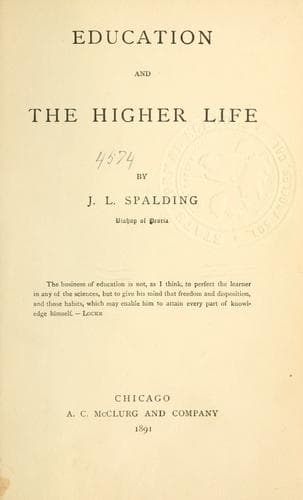
Education and the Higher LifeSpalding, John Lancaster
Religion
Education and the Higher Life
Spalding, John Lancaster
Education
Why shall he whose mind is free, symmetrical, and open, be tempted to
vain glory, to frivolous boasting? Shall not life be more solemn and
sacred to him than to another? Shall he indulge scorn for any being whom
God has made, for any thought which has strengthened and consoled the
human heart? Shall he not perceive, more clearly than others, that the
unseen Power by whom all things are, is akin to thought and love, and
that they alone bring help to man who make him feel that faith and hope
mean good, and are fountains of larger and more enduring life? The
highest mind, like the purest heart, is a witness of the soul and of
God.
CHAPTER IV.
CULTURE AND THE SPIRIT OF THE AGE.
But try, I urge,--the trying shall suffice: The aim, if reached or
not, makes great the life.
BROWNING.
The mass of mankind, if we pass the whole race in review, are sunk in
gross ignorance; and even in civilized nations, where education is free,
the multitude have but a rude acquaintance with the elements of
knowledge. Their ability to read and write hardly serves intellectual
and moral ends; and such learning as they possess seems only to weaken
their power to admire and love what is best in life and thought.
If we turn to the more cultivated, whose numbers even in the most
enlightened countries are not great, we find but here and there an
individual who has anything better than a sort of mechanical cleverness.
Students, it has been said, on leaving college, quickly divide into two
classes,--those who have learned nothing, and those who have forgotten
everything. In the professions, the lawyer tends to become an advocate,
the physician an empiric, the theologian a dogmatist; and these are but
instances of a general falling away from ideals. The student of physical
science is subdued to what he works in; the man of letters loses depth
and earnestness; and the teacher, whose business it is to rouse and
illumine souls, shrivels until he becomes merely a repeater of facts and
doctrines in which there is no life, no power to exalt the imagination
or to give tone to the intellect. The teacher cannot create talent, and
his best work lies in stimulating and directing energy and impulse; but
this he seldom strives to do or to make himself capable of doing; and
hence pupils very generally leave school as men quit a prison, with a
sense of emancipation, and with a desire to forget both the place and
the kind of life there encouraged. A talent is like seed-corn,--it bears
within itself the power to break the confining walls and to spring
upward to light, if only it be sown in proper soil, where the rain and
the sunshine fall; but this is a truth which those who make education a
business are slow to accept. They repress; they overawe; they are
dictatorial; they prescribe rules and methods for minds which can gain
strength and wisdom only by following the bent given by their
endowments,--and thus the young, who are most easily discouraged in
Public-domain text, read in full here on John Shaqi.
Reviews
Reviews
No reviews yet
Be the first to share your thoughts on this work.
Join the Discussion
Join the discussion
Sign in to leave a comment or review.
Sign InorCreate an account